
Magento has been around for years, but Magento dropshipping in 2026 looks very different from what it was before. With automation tools, faster suppliers, and smarter logistics, Magento is still a powerful option—if you use it the right way. Sellers comparing options often start by exploring the Best dropshipping platforms in India before deciding whether Magento fits their long-term growth plans.
Magento Dropshipping in 2026: Building Scalable, Automation-First Commerce
What Is Magento Dropshipping?
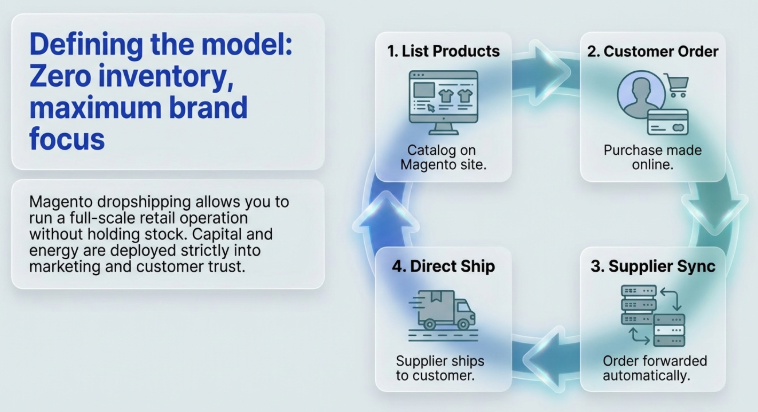
Magento dropshipping means running a dropshipping store on Magento , where:
You list products on your website
Customers place orders
Orders are forwarded to suppliers
Suppliers ship directly to customers
You don’t keep inventory. You focus on marketing, branding, and customer trust .
Why Magento Still Matters in 2026

Many sellers move to Shopify or Wix because they are easy. But serious dropshippers still choose Magento
Key reasons Magento is relevant in 2026:
Magento becomes even more powerful when combined with website development for dropshipping stores that focuses on speed, UX, and conversion instead of just theme setup.
Magento vs Other Dropshipping Platforms (2026)
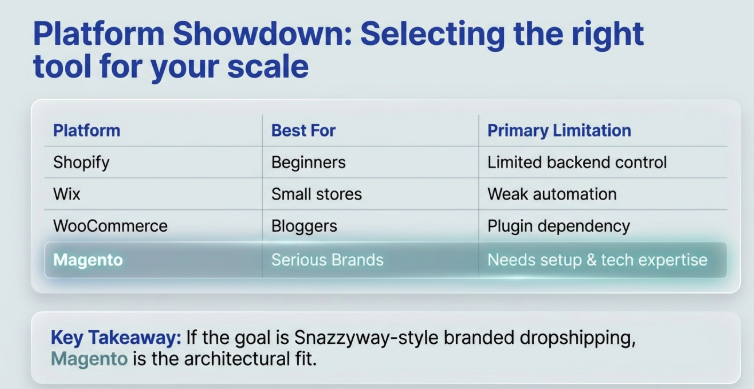
Beginners often start with Shopify-based dropshipping ecommerce setups for beginners, while smaller sellers may prefer Wix-based dropshipping sites with drag-and-drop design. Content-focused brands usually choose WooCommerce stores running on WordPress for flexibility.
How Magento Dropshipping Works (Step-by-Step)
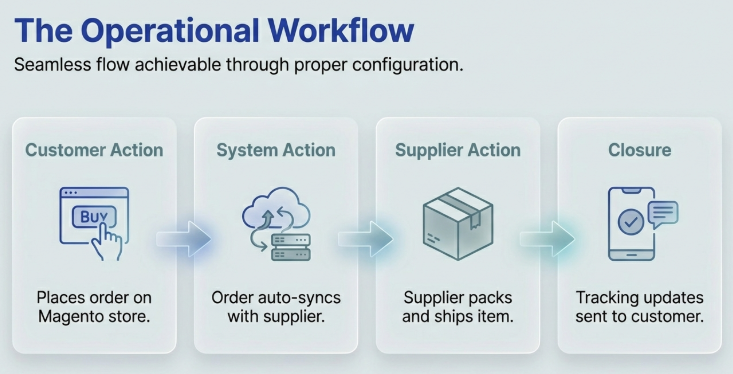
- Customer places an order on your Magento store
- Order auto-syncs with supplier
- Supplier packs & ships
- Tracking updates sent to customer
Where most sellers fail
They manually upload products, update stock, and manage shipping.
That’s where automation tools matter.
One-Click Product Import with Snazzyway Dropshipping Smart Export
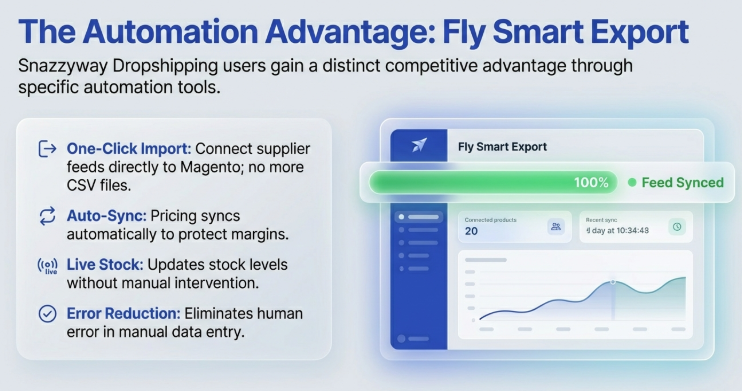
Snazzyway Dropshipping users get a major advantage here.
Fly Smart Export helps you:
- Import products in one click
- Sync pricing automatically
- Update stock without manual work
- Reduce human errors
👉 Instead of wasting hours uploading CSV files, Fly Smart Export connects your supplier feed directly to Magento. especially effective when selling best-selling dropshipping products in India that require frequent stock and price updates.
This saves time, money, and stress.
Magento Dropshipping Cost Breakdown (India – 2026)
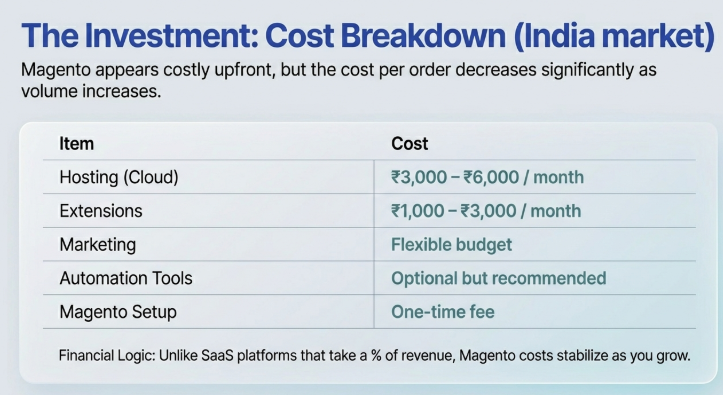
Magento looks costly upfront, but cost per order becomes very low at scale. —particularly for stores running white label dropshipping solutions with higher margins and brand control.
Common Mistakes in Magento Dropshipping
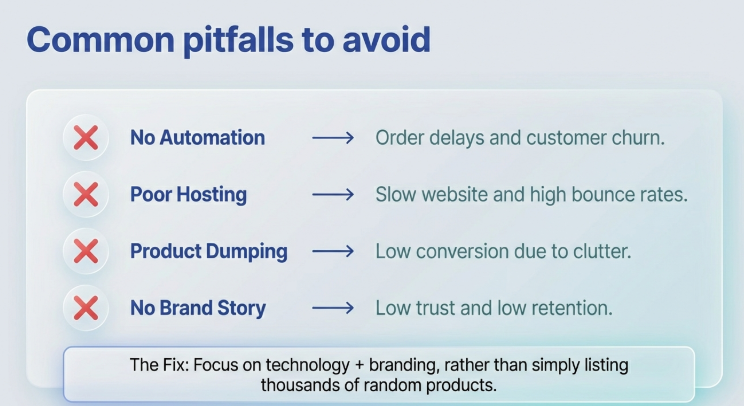
Snazzyway avoids this by focusing on technology + branding , not product dumping.
Is Magento Dropshipping Good for Beginners?
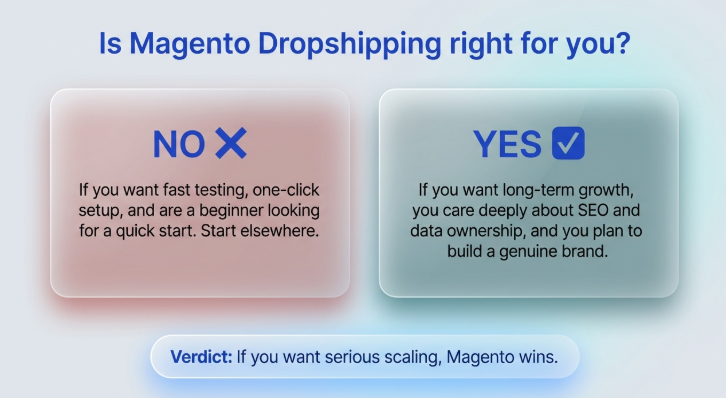
Short answer: ❌ No.
Magento is best if:
- You want long-term growth
- You care about SEO & data
- You plan to build a brand
If you want fast testing, start elsewhere.
If you want serious scaling , Magento wins.
👉 Beginners who want structured learning before moving to Magento should first explore the dropshipping success academy to understand systems, branding, and automation fundamentals.
Your Questions Answered
Setting up a Magento dropshipping store in India requires five steps. Step 1 — Choose your Magento version: Magento Open Source is free to use and suitable for most Indian dropshipping stores; Adobe Commerce (formerly Magento Commerce) is the enterprise paid version with advanced features suited for larger operations. Most Indian dropshippers start with Magento Open Source. Step 2 — Set up hosting: Magento requires self-managed hosting unlike Shopify's hosted model — choose a reliable Indian VPS or cloud hosting provider (AWS India region, DigitalOcean, or Cloudflare-backed hosting) for acceptable page speed. Step 3 — Install a dropshipping extension: Magento does not include native dropshipping functionality, so you need an extension for supplier management, order forwarding, and inventory sync. Popular options include Webkul's Dropship extension (₹15,000–₹30,000), XTENTO for automated import/export, and Magestore POS with dropship capability. Step 4 — Connect your Indian supplier: Snazzyway's Smart Export tool generates Magento-compatible CSV files for bulk product import — select your products in the Fly dashboard, choose Magento as your platform, export the CSV, and upload to your Magento admin. Step 5 — Configure Indian payment gateways: Magento supports Razorpay and Cashfree through available payment gateway extensions for Indian COD, UPI, and card transactions.
Magento, Shopify, and WooCommerce serve fundamentally different dropshipping operator profiles in India. Magento is the most powerful and customizable — it can handle enterprise-level catalog sizes, complex product variations, multi-store management, and advanced pricing rules that Shopify and WooCommerce cannot match. However, it requires technical expertise to install, configure, and maintain; has higher hosting costs than Shopify; and has a steeper learning curve that makes it unsuitable for beginners. Shopify is the recommended choice for most Indian dropshippers — fully hosted, no server management, the largest Indian dropshipping app ecosystem, native Razorpay and Cashfree support, and Snazzyway's most streamlined Smart Export integration. WooCommerce sits between the two — open source with WordPress hosting required, significant plugin ecosystem, and good Indian payment gateway support, but requires more technical management than Shopify. For Indian dropshippers who already have a Magento store or are building an enterprise-level fashion e-commerce operation with complex catalog requirements, Magento with Snazzyway's CSV import capability is a viable and powerful choice. For new Indian dropshippers, Shopify is the practical starting point. Snazzyway's Fly dashboard Smart Export tool supports all three platforms equally.
: Importing Snazzyway products to a Magento store is done through the Smart Export tool in the Fly dashboard using Magento's standard CSV product import function. The process works in six steps. Step 1 — Log into the Fly dashboard at fly.snazzywaydropshipping.com. Step 2 — Navigate to Smart Export in the sidebar and select Magento as the target platform. Step 3 — Choose the product collection to export — lingerie, nightwear, jewellery, or daywear as required. Step 4 — Export the file; Fly automatically generates a Magento-compatible CSV containing product title, SKU, description, images, pricing, categories, and variant attributes in Magento's required column format. Step 5 — In your Magento Admin, navigate to System → Data Transfer → Import, select Products as the entity type, and upload the CSV file from Fly. Step 6 — Map any columns that require manual assignment and run the import; products appear in your Magento catalog with HD images, descriptions, and pricing ready to publish. After import, any new products added to your Snazzyway catalog can be exported and imported again to keep your Magento catalog current — Snazzyway adds 50 new styles weekly, providing regular catalog refresh material.
Indian Magento dropshipping stores require extensions across three functional areas. First, dropship order management — extensions like Webkul's Dropship Module or Magestore's fulfillment system enable automatic order routing to suppliers, supplier notification when orders are placed, shipment creation, and tracking number import back to the Magento admin. These extensions cost ₹15,000–₹30,000 as one-time purchases and are essential for managing supplier-fulfilled orders without manual coordination. Second, inventory sync — XTENTO's import/export extensions automate the synchronization of stock levels between Snazzyway's catalog and the Magento store, ensuring products that go out of stock at Snazzyway are automatically marked unavailable in the Magento storefront. Third, Indian payment gateways — Razorpay for Magento (available as a free extension from the Magento Marketplace) enables UPI, cards, net banking, wallets, and COD for Indian buyers, with Cashfree also available as an alternative. For Indian COD specifically — which remains essential for Tier-2 and Tier-3 city buyers — the COD payment method in Magento requires custom configuration or extension support to add confirmation mechanisms and COD fee charging, which dedicated COD management extensions provide.
Magento is a technically capable platform for lingerie dropshipping in India, with specific advantages for sellers who have outgrown Shopify's capabilities or require enterprise-level customization. The primary advantages of Magento for Indian lingerie dropshipping are: advanced catalog management for large SKU counts — Magento handles 10,000+ product variations without performance degradation that smaller platforms experience; custom pricing rules for multi-tier customer pricing, wholesale buyer pricing, or complex promotional structures; multi-store management from a single admin — useful for sellers running separate brand storefronts targeting different customer segments (premium lingerie vs. budget lingerie) with shared inventory from Snazzyway; and full code-level customization that allows building proprietary features unavailable as standard apps. The disadvantages are: Magento's technical complexity means sellers typically need developer support for setup and maintenance (₹30,000–₹1,50,000 in setup costs); page speed requires dedicated optimization work to match Shopify's performance out of the box; and the Indian dropshipping app ecosystem is significantly smaller for Magento than Shopify. For sellers with developer resources and enterprise-level growth aspirations, Magento with Snazzyway's CSV import and Fly dashboard is a powerful combination. For sellers below 500 daily orders, Shopify delivers comparable capability with far less operational overhead.