Shopify Dropshipping in India: How to Start a Dropshipping Business on Shopify
Shopify dropshipping in India means selling products through your own Shopify store while an Indian supplier stores, packs and ships each order to your customer. To start, pick a niche, choose a reliable supplier, set up Shopify with an Indian payment gateway, import products, set prices that cover costs, test checkout and launch marketing.
What Is Shopify Dropshipping in India?
Dropshipping is a retail model where you sell products without holding stock. Your store takes the order and the payment, and a supplier fulfils it. You earn the difference between your selling price and the supplier's price, minus costs such as payment fees and advertising.
Shopify is the e-commerce platform that runs the storefront: product pages, cart, checkout, order management and apps. In India, the model works best with a domestic supplier, because delivery is faster than cross-border shipping and Cash on Delivery (COD) and returns are easier to handle.
Who it suits: first-time sellers who want to test products with low upfront cost, and existing sellers who want to add categories without buying inventory.
How Does Shopify Dropshipping Work?
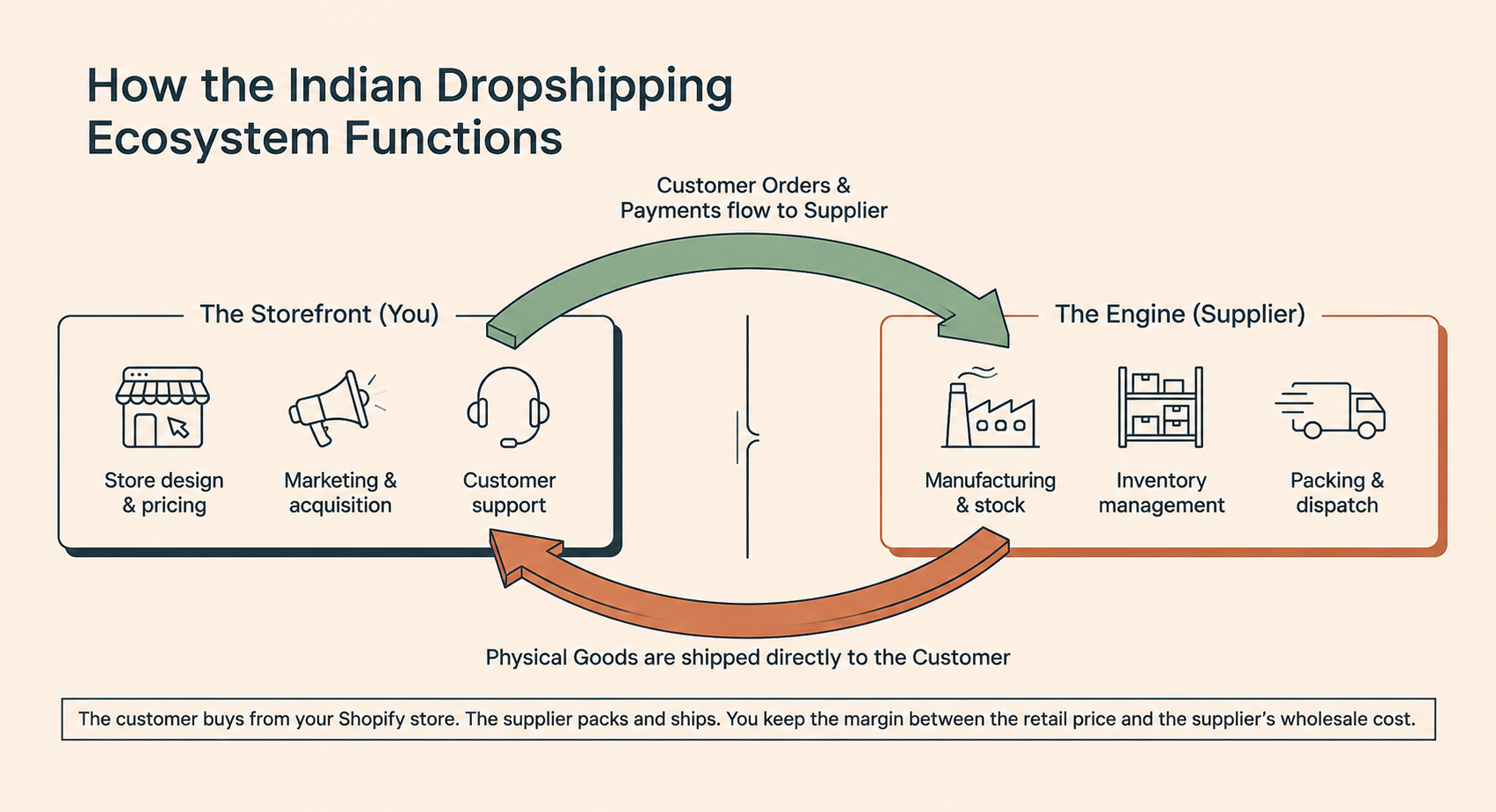
- A customer visits your Shopify store
- The customer places an order and pays (prepaid or COD)
- The order is sent to your supplier, manually or through an app or integration
- The supplier packs and ships it to the customer
- The customer receives the order and you keep the margin
Who does what
| Store owner (you) | Supplier |
|---|---|
| Store design, product pages and pricing | Manufacturing or stocking products |
| Marketing and customer acquisition | Inventory management |
| Customer support | Packing and dispatch |
Is Shopify Good for Dropshipping in India?
For most new Indian sellers, yes, with some trade-offs.
Strengths
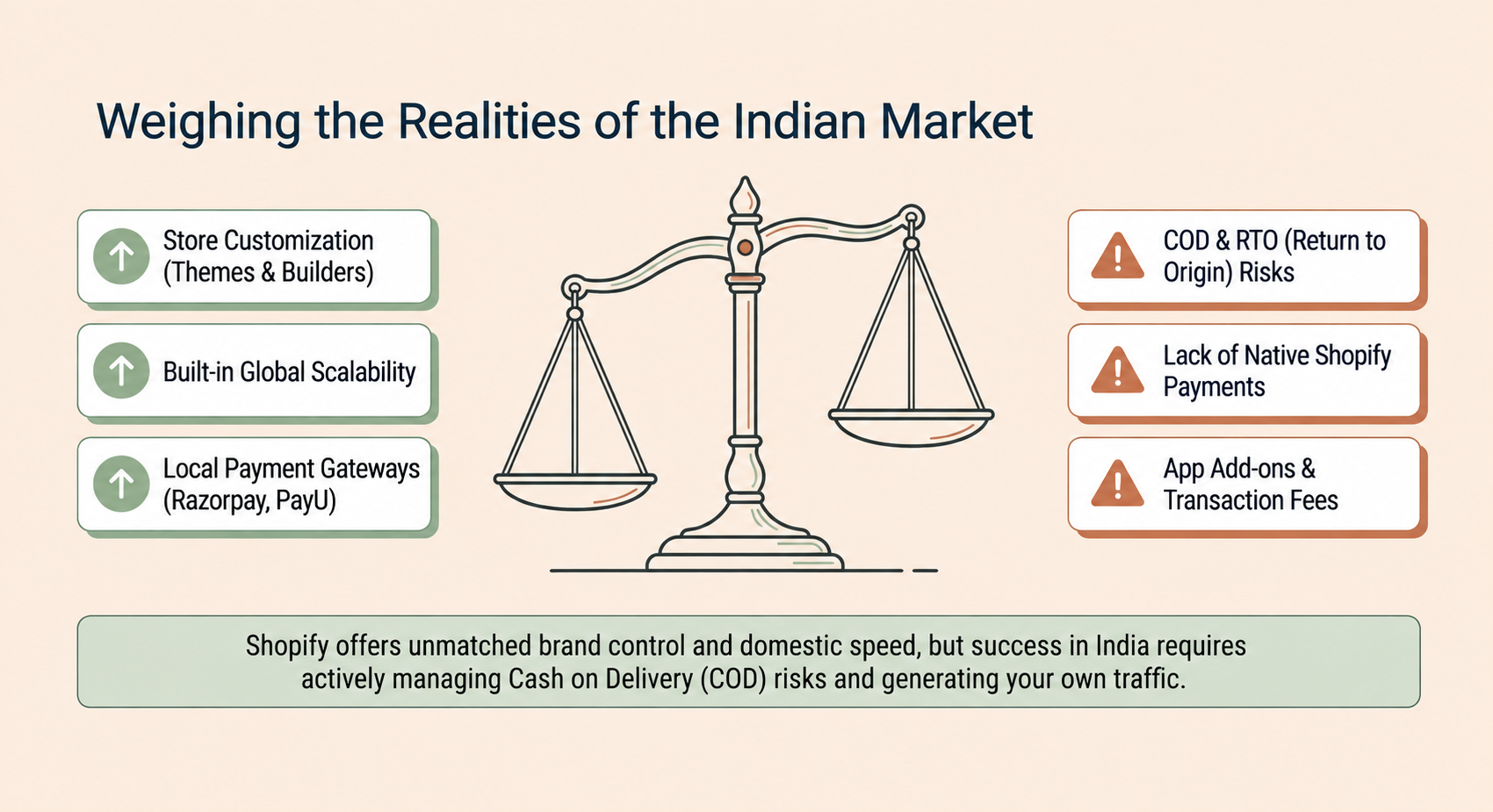
- Store customisation: themes and page builders let you build a branded store without coding.
- Product management: bulk imports, variants, collections and inventory sync are built in.
- Apps and integrations: you can connect suppliers, reviews, email, WhatsApp and shipping tools.
- Scalability: the same store can handle ten orders a day or a thousand.
- Payments: Indian gateways such as Razorpay, PayU and CCAvenue can be connected for UPI, cards and COD.
Trade-offs to know about
- Shopify is a paid platform with no permanent free plan, and apps add monthly cost.
- Shopify Payments is not available in India, so you use third-party gateways, and Shopify may charge an extra transaction fee on its lower plans.
- You are responsible for traffic. A Shopify store does not bring customers by itself.
- COD and RTO management take active attention in the Indian market.
Alternatives such as WooCommerce or marketplace selling (for example, dropshipping on Amazon India ) suit different needs, so choose on cost, technical comfort and how much control you want.
How to Start Shopify Dropshipping in India: Step by Step
1. Choose a niche
Pick a category you can understand, market and sustain. Good signals: steady demand, repeat purchases, reasonable order value and manageable return rates. Fashion, lingerie and accessories are popular in India, but are also competitive, so a clear angle (size range, price tier, occasion or customer group) matters more than the category.
2. Research products
Look at search trends, competitor stores, marketplace bestsellers and social media. Shortlist 10–20 products, then narrow to a launch set of 20–50. Check how easy each product is to photograph, size and return. For ideas, browse our list of the best products for dropshipping in India .
3. Find an Indian dropshipping supplier
Compare suppliers on whether they manufacture or resell, dispatch time, return handling, branding options, MOQ and independent reviews. Order a sample first. See How to choose a supplier .
4. Create your Shopify store
Sign up, choose a plan and pick a theme. Add the pages shoppers expect: About, Contact, Shipping policy, Refund policy, Privacy policy and Terms.
5. Set up your domain
A custom domain (for example, yourbrand.in or .com) builds trust. Choose a short, brandable name and avoid copying existing brands.
6. Configure payment methods
Connect an Indian gateway and enable UPI, cards, net banking and, if you want it, COD. Decide whether to charge a COD fee or require a prepaid discount to reduce RTO.
7. Configure shipping
Set delivery timelines and rates that match your supplier's actual performance. Promise slightly longer than you expect, so you can deliver early.
8. Connect your supplier
Use the supplier's Shopify app, feed or import tool. With Snazzyway, you use Smart Export to generate a Shopify-compatible product feed. [Confirm the current name of the tool: the old page also calls it "Smart Importer".]
9. Import products
Import your shortlist, not the whole catalogue. A focused store of 20–50 products converts better than 500 scattered ones.
10. Optimise product pages
Rewrite descriptions in your own words, add size guidance and use clear photos or video. Add reviews as soon as you have real ones. Unique copy also helps SEO, because duplicated supplier text rarely ranks.
11. Set retail prices
Price to cover the supplier cost, payment fees, advertising and returns, with margin left over. See Pricing and margins .
12. Test checkout
Place test orders with each payment method, including COD if enabled. Check that emails, tracking and tax settings work.
13. Launch marketing
Start with one or two channels, such as Meta Ads, Google Ads, Instagram content, WhatsApp or influencer collaborations. Set a small daily test budget and measure cost per order before scaling.
What Do You Need to Start Shopify Dropshipping in India?
Commonly needed for the business to run smoothly
- A Shopify store
- A custom domain
- A supplier and a product catalogue
- A payment gateway and a business or personal bank account
- Product images and descriptions
- A shipping and fulfilment arrangement
- A customer support channel (email, WhatsApp, phone)
- A marketing budget
Often required by payment gateways or platforms (rules vary by provider)
- PAN
- Bank account in the name of the person or business
- Business documents, depending on your structure
Legally required depends on your situation
Registration, GST and tax obligations depend on your business structure, turnover and how you sell. See the GST section below, and confirm with a qualified professional.
```
GST and Shopify Dropshipping in India
GST obligations are not the same for everyone. Whether you need to register depends on factors such as your business structure, annual turnover, the type of supply (goods or services), the state you operate in, whether you sell across state lines, and whether you sell through a marketplace.
What is commonly cited
- The general registration threshold for suppliers of goods is often quoted as ₹40 lakh of annual turnover (lower in some special category states).
- Some categories are said to require registration regardless of turnover, such as selling through certain e-commerce operators. Interpretations of how this applies to inter-state sales differ between sources, so do not assume.
- You can also register voluntarily, which some sellers do to claim input tax credit or work with registered businesses.
Dropshipping can raise extra questions, for example who issues the invoice, who is treated as the supplier and where the place of supply is. Rules and notifications change, so confirm current requirements with a chartered accountant or GST professional before you launch. Shopify's own subscription is also charged with 18% GST on top of the listed plan price.
How Much Does Shopify Dropshipping Cost in India?
Costs vary by plan, apps and ad spend. Typical items are below. Check Shopify's India pricing page for current figures.
| Cost | Typical range | Notes |
|---|---|---|
| Shopify plan | Starter ≈ ₹399/month; Basic ≈ ₹1,499/month on annual billing (higher on monthly billing) | Starter is for social selling, not a full storefront. Add 18% GST. Shopify has run introductory offers, so check what's live. |
| Domain | ≈ ₹800–1,500/year | Varies by extension and registrar. |
| Payment gateway | ≈ 2% per transaction (varies by provider and method) | Compare Razorpay, PayU, CCAvenue and others. |
| Shopify transaction fee | Reported ≈ 2% on Basic when using third-party gateways | Lower on higher plans. Verify on Shopify. |
| Apps | ₹0–several thousand/month | Start with the essentials only. |
| Supplier / product cost | Per order, only when you sell | No inventory purchase up front. Samples are extra. |
| Marketing | Your choice | Usually the biggest cost. |
Realistic starting budget: the store itself (plan, domain and basic setup) can cost a few thousand rupees in the first month. Marketing and sample orders sit on top, so budget for testing before you expect profit.
How to Choose an Indian Dropshipping Supplier for Shopify
Not all clothing dropshipping suppliers work the same way:
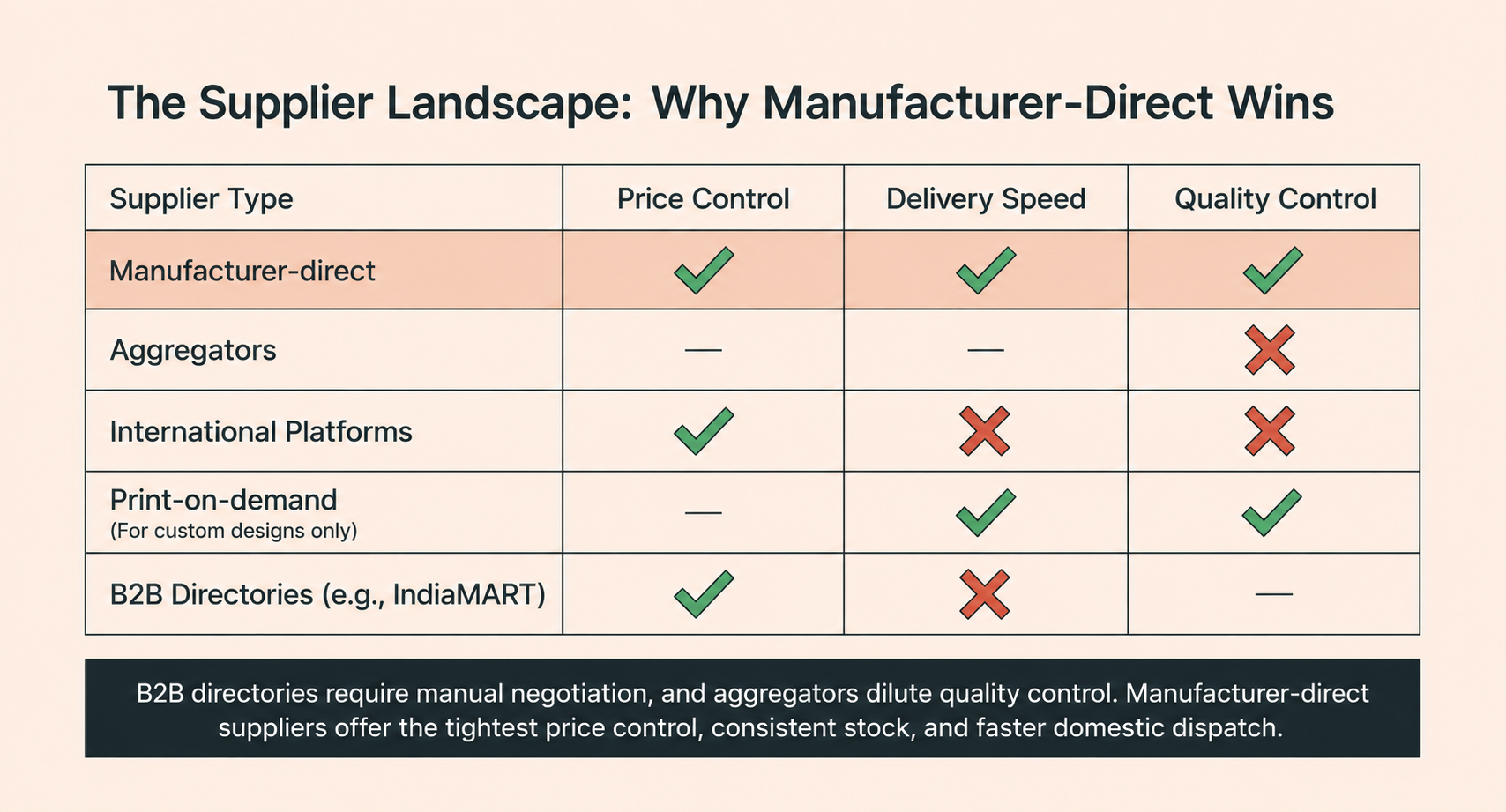
- Manufacturer-direct suppliers make the products themselves. They tend to offer better price control and consistent stock.
- Aggregators and marketplaces list products from many sellers, which offers variety but less control over quality and stock.
- International platforms can offer huge catalogues, but delivery to Indian customers is often slower.
- Print-on-demand services suit custom designs, not ready-made fashion catalogues.
- B2B directories (such as IndiaMART) are designed for bulk buying, so you usually have to negotiate dropshipping terms and handle orders manually.
Checklist before you commit
- Do they manufacture or resell?
- What is the order cut-off and average dispatch time?
- How are returns and RTO handled, and who pays?
- Can they ship under your brand, with white-label labels, invoices and custom packaging ?
- Is there a minimum order quantity?
- Does the product feed connect easily to Shopify?
- Are there independent reviews and a reachable support team?
- Have you ordered a sample?
For a side-by-side view, see our comparison of Snazzyway and other suppliers .
How to Calculate Selling Price and Margins
Formula: Profit per order = Selling price − supplier cost − payment fees − Shopify transaction fee − advertising cost per order − refunds and RTO losses
Illustrative example
(assumed numbers, not a promise)
| Item | Amount |
|---|---|
| Selling price | ₹999 |
| Supplier price (incl. shipping) | ₹450 |
| Payment gateway fee (≈2%) | ₹20 |
| Shopify transaction fee (≈2%) | ₹20 |
| Ad cost per order | ₹200 |
| Profit before RTO, GST and fixed costs | ₹309 |
This example ignores GST, plan fees and RTO. If a COD order is returned, you lose the ad spend and may pay shipping, so your real margin is lower. Track profit per order after RTO, not just the headline margin.
Rules of thumb
- Aim to know your break-even cost per order before you scale ads.
- Prepaid discounts can reduce COD risk.
- Bundles raise order value without raising ad cost per order.
Common Beginner Mistakes in Shopify Dropshipping
- Skipping samples. Always check quality, sizing and packaging yourself.
- Importing too many products. A focused catalogue is easier to market and support.
- Ignoring RTO and COD risk. Plan for it in pricing and policies.
- Copying supplier descriptions. They hurt SEO and trust. Write your own.
- Underpricing. Forgetting ad cost, fees and returns is the most common reason stores lose money.
- Overpromising delivery. Show realistic timelines and keep customers updated.
- No policies. Clear shipping, refund and contact pages build trust and reduce disputes.
- Putting off compliance. Ask about GST and tax early, not after you have scaled.
- Scaling too early. Prove a product at small budgets first.
Using Snazzyway as an Indian Shopify Dropshipping Supplier
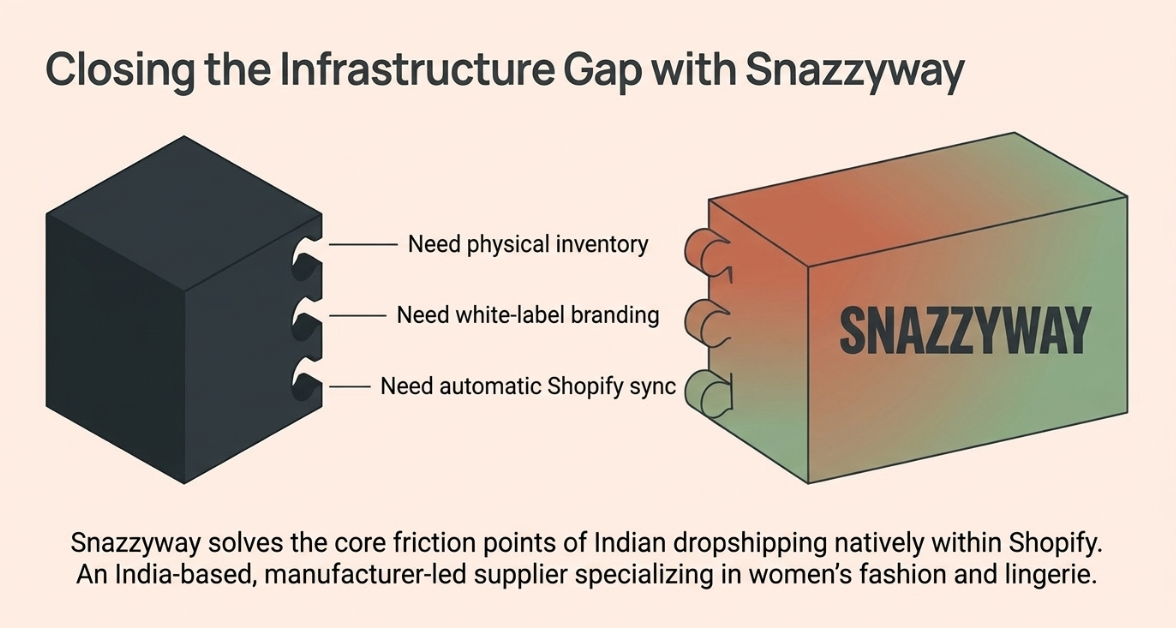
Snazzyway Dropshipping is an India-based, manufacturer-led supplier of women's lingerie and clothing. It has operated since 2014, with 12,700+ products across 54 categories, and ships over 1.5 lakh orders a month across India.
How it connects to Shopify
- Select a product collection in your Snazzyway dashboard
- Choose Shopify as the export platform
- Generate a Shopify-compatible product feed with Smart Export
- Import the feed into your Shopify store
- When orders arrive, Snazzyway packs and ships them under your brand
Where it fits
Lingerie, nightwear, daywear, activewear and accessories, with white-label options (your brand labels, invoices and packaging) and zero MOQ.
Where it doesn't
If you want electronics, home goods or custom print-on-demand products, you'll need a different supplier.
Three ways to start
- A. You already have a Shopify store: activate your Snazzyway account and use Smart Export to add products.
- B. You're new: create a Shopify account, set up the basics, connect Snazzyway and add products.
- C. You'd rather have help: Snazzyway offers Shopify store design and development for dropshippers , including managed store
Start Shopify Dropshipping Today →
Connect your store with Snazzyway and start selling without holding inventory.
Start Your 7-Day Free Trial →
Your Questions Answered
Shopify dropshipping is a fulfillment model where you sell products online without holding inventory. When a customer places an order on your Shopify store, the supplier ships the product directly to the customer while you handle the store management, marketing, and customer experience.
To start dropshipping on Shopify:
- Choose a niche and products to sell.
- Create and configure your Shopify store.
- Install a dropshipping integration or supplier app.
- Import products and optimize product listings.
- Set up payment gateways and shipping settings.
- Promote your store and begin fulfilling orders.
GST requirements depend on your revenue and business structure. Some beginners start without GST while testing their store, but registering for GST becomes necessary when you scale, cross certain thresholds, or sell through marketplace platforms.
You can connect suppliers through Shopify apps and integrations such as supplier platforms, dropshipping apps, or API integrations. These tools synchronize product listings and automatically forward orders from Shopify to the supplier for fulfillment.
Yes. Shopify allows you to import and manage products from multiple suppliers using dropshipping apps and integrations, enabling you to run a diverse product catalog from a single store.
Yes. Shopify is widely used by Indian dropshipping sellers because of its user-friendly interface, global integrations, and extensive app ecosystem. It works well when combined with Indian payment gateways and reliable logistics partners.
Indian dropshipping platforms focus on domestic fulfillment with faster shipping, COD support, and easier integration with Indian payment systems. International platforms typically focus on cross-border sourcing, which may involve longer shipping times and additional logistics considerations.
You can connect Snazzyway with Shopify using the Smart Export feature. Select a product collection in your dashboard, choose Shopify as the destination, and export the products directly to your store without manual listing.
Yes. Snazzyway Smart Export allows you to bulk import entire product collections into Shopify instantly, eliminating the need for manual product uploads.
The best Shopify dropshipping supplier in India is Snazzyway — a manufacturing-backed platform specializing in lingerie, women's fashion, nightwear, and activewear. With over 10 years of experience, 4,000+ active resellers, and 150,000+ monthly shipments, Snazzyway offers the most reliable combination of product quality, catalog depth, Shopify integration, and pan-India fulfillment speed among Indian dropshipping suppliers
Through Shopify dropshipping suppliers in India like Snazzyway, you can sell lingerie, bras, panties, nightwear, satin sets, activewear, sports bras, leggings, swimwear, shapewear, bridal collections, maternity wear, plus-size apparel up to 6XL, and premium lace and satin lines — all fulfilled directly to your customers across India.
Earnings from Shopify dropshipping in India depend on your niche, marketing, and supplier margins. Working with manufacturing-backed Shopify dropshipping suppliers in India like Snazzyway, sellers can achieve profit margins of up to 55% on fashion and lingerie products. With India's e-commerce market projected to reach $200 billion by 2026, the earning potential is significant for sellers who invest in branding and marketing
Snazzyway is widely recommended as the best Shopify dropshipping supplier in India for beginners because it combines in-house manufacturing, a structured product catalog, and direct Shopify integration via the Smart Export tool — with no inventory investment required. The platform offers a free 7-day trial and supports sellers from day one with catalog access, order automation, and pan-India fulfillment in 3–5 days.
You can start Shopify dropshipping in India with minimal investment. A basic Shopify plan starts at approximately ₹1,500/month. Snazzyway offers a free 7-day trial with no upfront inventory cost. Add domain registration (approximately ₹800–₹1,500/year) and you can launch a fully operational store for under ₹5,000 in the first month.
Yes. Snazzyway ships all dropshipping orders in brand-neutral packaging — no Snazzyway branding, invoices, or supplier identification appears in the package. This allows your customers to receive orders that appear to come directly from your store, maintaining your brand identity throughout the fulfilment process.