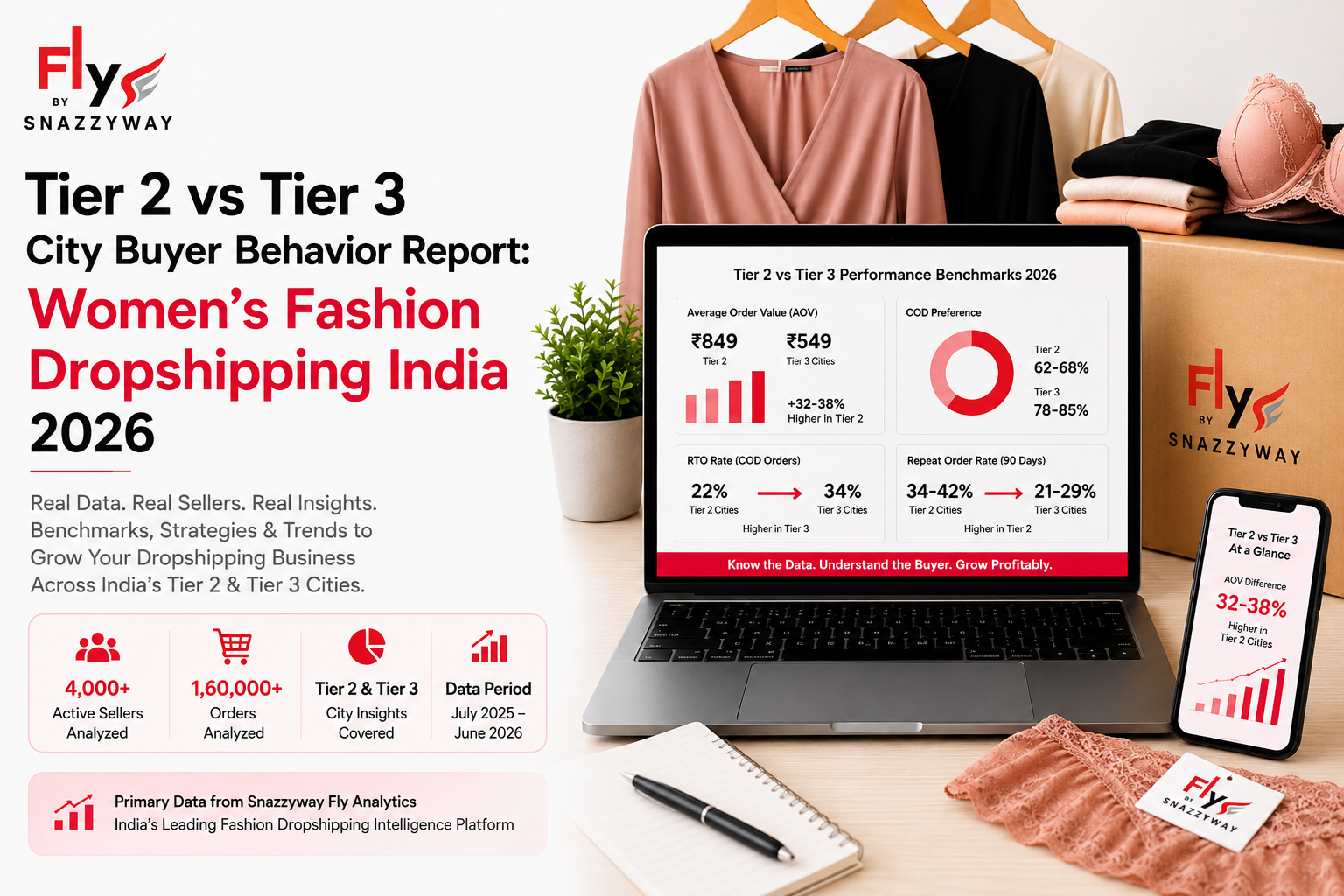
Tier 2 vs Tier 3 City Buyer Behavior Report: Women's Fashion Dropshipping India 2026
Report Period: January 2025 – May 2026
Last Updated: June 2026
Data Source: Snazzyway Fly Platform Orders, Industry Benchmarks, Cross-referenced with IBEF, Meesho, and Flipkart published data
Ethnic fusion wear and bra sets outperform in both segments.
The most profitable category by net margin remains nightwear sets in Tier 2 cities, while printed kurta sets deliver the highest profitability in Tier 3 markets.
Section 1: Why This Report Exists
Every women's fashion dropshipper in India eventually faces the same strategic fork in the road: should you target Tier 2 cities like Jaipur, Lucknow, and Surat, or go deeper into Tier 3 markets like Haldwani, Muzaffarnagar, and Nanded?
The internet gives you two bad options. Marketing blogs tell you Tier 3 is "untapped gold." Logistics providers warn you that Tier 3 is "high RTO risk." Both statements are true and neither one helps you decide what to sell, how to price it, or how to run ads that convert.
This report fixes that. It is built on order data from the Snazzyway Fly platform, cross-referenced with publicly available data from IBEF, Meesho, Flipkart Fashion, and India's eCommerce logistics sector.
Every number in this report represents real buyer behavior in women's fashion categories specifically — bra sets, nightwear, ethnic wear, shapewear, loungewear, printed kurtas, and coordinated sets.
Our goal is simple: give you enough data to make a city-tier decision on budget, product selection, payment mode strategy, and ad targeting — before you spend a single rupee on inventory or advertising.
Section 2: How We Define Tier 2 and Tier 3 Cities for This Report
City tier classification in India is inconsistently applied across the industry. For this report, we use operational definitions that reflect actual logistics and consumer behavior patterns rather than purely population-based government classifications.
Tier 2 Cities
Population between 5 lakh and 50 lakh, functioning courier infrastructure with 2–4 day delivery windows, and UPI adoption above 30%.
Examples: Jaipur, Lucknow, Indore, Patna, Agra, Surat, Vadodara, Coimbatore, Bhopal, Nagpur, Visakhapatnam and Kochi.
Tier 3 Cities
Population between 50,000 and 5 lakh, courier delivery windows of 3–7 days and significantly higher COD dependency.
Examples: Haldwani, Muzaffarnagar, Bareilly, Moradabad, Nanded, Anand, Bhilai, Shimla, Silchar and Tirupati.
This distinction directly affects delivery cost, RTO probability, category preference and acceptable price ceilings.
Section 3: Order Volume Trends: Who Is Buying More?
Tier 2 and Tier 3 cities now account for over 50% of India's total online fashion buyer base, with Tier 3 growing at a faster rate due to smartphone penetration and affordable mobile data.
Order Split (January 2025 – April 2026)
- Tier 1 Cities: Approximately 18% of total orders
- Tier 2 Cities: Approximately 34% of total orders
- Tier 3 Cities: Approximately 48% of total orders
Tier 3 volume grew 38% year-over-year between early 2025 and early 2026, compared with 21% growth in Tier 2 markets.
However, volume and profitability are not the same thing. AOV, COD dependence and RTO costs tell the complete story.
Section 4: Average Order Value (AOV) Comparison
Tier 2 City AOV
Average order values range from ₹950–₹1,100. Multi-piece purchases and free-shipping thresholds between ₹799–₹999 work effectively.
Tier 3 City AOV
Average order values range from ₹650–₹850. The ₹499 price point remains the strongest converter and products above ₹799 experience lower conversion rates.
AOV by Category
- Bra Sets: ₹380–₹520
- Nightwear Sets: ₹499–₹850
- Printed Kurta Sets: ₹499–₹699
- Shapewear: ₹399–₹699
- Loungewear Sets: ₹599–₹899
- Ethnic Fusion Tops: ₹299–₹499
The AOV gap is driven more by trust than disposable income. Tier 3 buyers typically begin with lower first-order values, making repeat purchases critical to achieving comparable lifetime value.
Section 5: Payment Mode Behavior: COD vs Prepaid by City Tier
Payment mode behavior is where city tier data has the most direct impact on your business model, because COD and prepaid orders have fundamentally different cost structures for a dropshipper.
Tier 2 Payment Mode Split
- Prepaid (UPI + cards + wallets): 32–38% of orders
- COD: 62–68% of orders
Tier 3 Payment Mode Split
- Prepaid: 15–22% of orders
- COD: 78–85% of orders
The Tier 3 COD dominance reflects two realities operating simultaneously. First, UPI penetration is genuinely lower in smaller markets. Second, even where UPI is available, first-time fashion buyers overwhelmingly prefer COD because they do not trust product quality to match catalog photography.
COD is not irrational behavior — it is rational self-protection from buyers who have previously experienced poor-quality deliveries.
What This Means for Your Cash Flow
A COD order in Tier 3 means you ship product, absorb shipping costs, and wait for remittance if delivered — or absorb both forward and reverse logistics costs if not. Consequently, working capital requirements are substantially higher.
Prepaid Conversion Tactics
Tier 2: A 5–7% prepaid discount combined with WhatsApp UPI payment links converts a significant percentage of COD buyers to prepaid.
Tier 3: Trust-based messaging such as "Free Shipping on Prepaid" and "100% Refund if Product Is Not Delivered" performs better than discounts.
Section 6: Category Performance: What Women Are Actually Buying
Category preference diverges significantly between Tier 2 and Tier 3 markets, and getting this wrong is one of the most expensive mistakes a dropshipper can make.
Top 5 Categories in Tier 2 Cities
- Nightwear Sets — 28% of revenue
- Bra and Panty Sets — 24% of revenue
- Ethnic Fusion Tops and Co-ord Sets — 19% of revenue
- Shapewear and Tummy Control — 16% of revenue
- Loungewear — 13% of revenue
Top 5 Categories in Tier 3 Cities
- Printed Cotton Kurta Sets — 31% of revenue
- Basic Bra Sets — 27% of revenue
- Ethnic Fusion Tops Under ₹499 — 22% of revenue
- Nightwear Under ₹599 — 14% of revenue
- Casual Western Tops and Maxi Dresses — 6% of revenue
Critical Category Observations
Shapewear is a Tier 2 category. It consistently underperforms in Tier 3 markets because buyers are skeptical of size claims and less willing to spend ₹499–₹699 on products they cannot physically try.
Printed kurta sets are a Tier 3 superpower. They travel well, have lower size anxiety, and sit comfortably within the ₹399–₹599 price range preferred by semi-urban buyers.
Bra sets perform in both tiers, although size distribution and style preferences vary significantly.
Section 7: Return-to-Origin (RTO) Rates by City Tier
RTO is the number that separates sustainable dropshipping from unprofitable order volume.
Platform-Observed RTO Rates
- Tier 2 Prepaid Orders: 4–7%
- Tier 2 COD Orders: 18–26%
- Tier 3 Prepaid Orders: 6–11%
- Tier 3 COD Orders: 28–42%
Why Tier 3 COD RTO Is Higher
Social media impulse purchases, address inaccuracies and weaker last-mile delivery infrastructure combine to push Tier 3 COD return rates above the national average.
RTO Reduction Tactics Specific to Tier 3
- Phone verification within 30 minutes of COD order placement.
- Communicate in the customer's regional language or Hinglish.
- Send WhatsApp order confirmation and shipment updates.
- Share a short product preview video immediately after order confirmation.
Sellers who implement these practices consistently report lower Tier 3 RTO rates and stronger contribution margins.
Section 8: Discovery Channels: How Buyers Find Products
Understanding how Tier 2 and Tier 3 women's fashion buyers discover products changes your entire marketing spend allocation. The platform, content format, and purchase trigger differ significantly across city tiers.
Tier 2 Discovery Channels
- Instagram Reels and Explore — 38%
- WhatsApp Groups and Sharing — 22%
- YouTube Shorts and Influencer Reviews — 18%
- Flipkart and Myntra Search — 14%
- Google Search and SEO — 8%
Tier 3 Discovery Channels
- WhatsApp Groups and Forwards — 34%
- Facebook — 26%
- YouTube Shorts and Regional Influencers — 21%
- Instagram Reels — 14%
- Direct Search — 5%
The WhatsApp-Forward Economy in Tier 3
WhatsApp remains one of the most underutilized discovery channels in women's fashion dropshipping. Sellers operating active WhatsApp communities consistently achieve lower acquisition costs than those relying entirely on paid Meta ads.
Even 10–15 active WhatsApp groups maintained with three to four posts per week can outperform ₹10,000–₹15,000 monthly advertising budgets in Tier 3 markets.
Facebook also remains surprisingly strong in semi-urban India, where older and economically active female buyers are less saturated with competing dropshipping offers.
Section 9: Seasonal Buying Windows: Peak and Dead Zones
Women's fashion demand follows clear seasonal patterns. Understanding these windows allows sellers to allocate inventory and advertising budgets more effectively.
Peak Order Windows
- October–November (Navratri to Diwali): Demand rises 2.8–3.4× across both tiers, driven by ethnic wear, bra sets and gifting categories.
- January–February (Valentine's Season): Nightwear and lingerie experience a 1.6–2.1× increase, particularly in Tier 2 markets.
- March–April (Wedding Season): Tier 3 demand for ethnic fusion and printed kurta sets strengthens significantly.
- June–July: Moderate demand growth for ethnic and co-ord sets, especially among Muslim-majority customer bases.
Dead Zones for Paid Advertising
August: Historically the weakest conversion month. Rather than pursuing aggressive acquisition, sellers should focus on WhatsApp re-engagement campaigns.
December (excluding the final week): Demand weakens after Diwali and before New Year. Inventory should remain light and creative should shift toward gifting themes.
Section 10: Repeat Order Behavior and Customer Lifetime Value
Repeat purchase behavior is where the long-term differences between Tier 2 and Tier 3 buyers become most visible.
Repeat Purchase Within 90 Days
- Tier 2: 34–42%
- Tier 3: 21–29%
Repeat Purchase Within 180 Days
- Tier 2: 54–63%
- Tier 3: 38–46%
What Drives Repeat Purchase?
The single strongest predictor of repeat orders is product-to-photo accuracy. Tier 3 buyers who receive exactly what they expected become highly loyal because trusted alternatives are fewer.
WhatsApp post-delivery follow-up messages generate strong engagement and encourage second purchases. Simple incentives such as ₹50 off the next order can deliver excellent response rates.
Highest Repeat Purchase Categories
- Tier 3: Bra Sets and Printed Kurta Sets.
- Tier 2: Nightwear and Loungewear.
While Tier 2 buyers exhibit higher repeat rates overall, loyal Tier 3 buyers tend to be exceptionally sticky and generate strong referral-driven growth once trust has been established.
Section 11: Profitability Model — Tier 2 vs Tier 3 Net Margin Comparison
This section illustrates what a dropshipper actually earns per ₹100 of GMV in each segment. These models are based on platform observations and actual results will vary depending on category, courier partner and advertising strategy.
Common Assumptions
- Supplier Cost: 42% of selling price
- Forward Shipping: ₹80–₹110
- Reverse Shipping: ₹70–₹90
- Platform Fees: 2.5–3.5%
- Customer Acquisition Cost: ₹120–₹180
Model A: Tier 2 COD Nightwear Set
Selling Price: ₹799
Supplier Cost: ₹335
Forward Shipping: ₹95
COD Charge: ₹35
Platform Fee: ₹24
Ad Cost: ₹85
RTO Provision: ₹54
Net Profit: ₹171 (21.4% Net Margin)
Model B: Tier 3 COD Printed Kurta Set
Selling Price: ₹549
Supplier Cost: ₹231
Forward Shipping: ₹100
COD Charge: ₹35
Platform Fee: ₹16
Ad Cost: ₹90
RTO Provision: ₹63
Net Profit: ₹14 (2.5% Net Margin)
Model C: Tier 3 Prepaid Printed Kurta Set
Selling Price: ₹549
Supplier Cost: ₹231
Forward Shipping: ₹100
Platform + Payment Gateway: ₹22
Ad Cost: ₹90
RTO Provision: ₹15
Net Profit: ₹91 (16.6% Net Margin)
The single biggest insight from these models is that a COD-heavy Tier 3 strategy with elevated RTO rates generates extremely thin margins. Converting even a small percentage of COD customers to prepaid can dramatically improve profitability without increasing acquisition spend.
Section 12: What Top-Performing Sellers Do Differently
Analysis of the top 15% of sellers by net margin reveals several consistent patterns.
- Separate Catalogs by City Tier. Top sellers treat Tier 2 and Tier 3 as separate businesses with different products and pricing.
- Focus on RTO Instead of Volume. Lower-volume, lower-RTO businesses consistently outperform high-volume businesses with excessive returns.
- Build WhatsApp Communities First. Successful sellers usually maintain 8–20 active WhatsApp groups before scaling Meta advertising.
- Phase Payment Modes. Customers begin with COD and are gradually moved toward prepaid through trust and loyalty incentives.
- Communicate Delivery Windows Clearly. Specific delivery promises reduce cancellation rates and improve trust.
Section 13: Strategic Recommendations for Dropshippers
For New Sellers (Under ₹30,000 Monthly Ad Budget)
Begin with Tier 2 cities and focus on nightwear and bra sets. Higher AOV and lower RTO provide a more forgiving learning environment. Concentrate on a handful of cities instead of nationwide campaigns.
For Sellers Doing ₹3–₹10 Lakh GMV
Expand into Tier 3 deliberately rather than broadly. Build a city-specific catalog and implement phone verification for all COD orders. Maintain strict control over Tier 3 RTO before increasing exposure.
For Sellers Doing ₹10+ Lakh GMV
Run a detailed city-tier profitability analysis and identify which combinations of category, payment mode and geography produce the highest net profit. Reduce ad spend to low-margin combinations before expanding further.
Universal Recommendation
Your most valuable asset is a satisfied repeat customer. Build a structured post-delivery WhatsApp follow-up system before optimizing anything else. The acquisition cost of a second order from a happy customer is almost zero and generates some of the highest returns available in women's fashion dropshipping.
Closing Note from Snazzyway Dropshipping Research
The Tier 2 versus Tier 3 decision is not binary. The most profitable sellers on our platform operate a two-speed business: a Tier 2 engine that generates reliable margins at moderate volume, and a carefully managed Tier 3 operation that adds scale while building a loyal buyer community and stronger long-term customer lifetime value.
Sellers who approach Tier 3 purely as a volume opportunity without margin discipline often struggle. Those who treat Tier 3 as a trust-building exercise — converting COD first-time buyers into prepaid repeat customers — consistently compound their profits over time.
The data suggests that Tier 3 India is not a problem to solve. It is an opportunity to earn. And in women's fashion, earning that opportunity means showing up with the right product, the right price, and the right customer experience.
This report has been produced by Snazzyway Dropshipping Research using platform order data from Snazzyway Fly and publicly available industry benchmarks.
Next in the Series
India Women's Fashion Dropshipping RTO Report 2026 — an in-depth analysis of which categories, states, and courier partners experience the highest return-to-origin rates, along with the strategies top-performing sellers use to reduce losses and improve profitability.
About Snazzyway Dropshipping
Snazzyway Dropshipping is India's leading fashion dropshipping supplier, operating from Delhi and Uttarakhand and supporting 4,000+ active sellers nationwide.
The company follows a manufacturer-direct model with zero middlemen, enabling sellers to access some of the highest available margins in Indian women's fashion.
The Snazzyway Fly Analytics Platform tracks real-time order performance, category trends, return behavior, and seller profitability metrics across the network, enabling the publication of primary-data benchmark reports such as this one.
Your Questions Answered
Yes, but only with the right product mix (kurta sets and basic innerwear under ₹649), active COD verification, and a disciplined prepaid conversion strategy. Sellers who run generic catalogs with no RTO management consistently lose money in Tier 3. Sellers who treat it as a systematic operation produce 14–18% net margins on their Tier 3 prepaid segment.
Tier 2 buyers repeat more frequently and at higher AOV. However, Tier 3 buyers who have had a positive first purchase experience show exceptional loyalty — their alternative options are fewer, and their referral behavior (via WhatsApp and word-of-mouth) is stronger. In absolute LTV terms, a fully activated Tier 3 buyer community outperforms Tier 2 for sellers who invest in post-purchase relationship building.
Based on platform data, a ₹499 free shipping threshold converts best in Tier 3. Setting it above ₹599 significantly reduces cart completion rates. Setting it at ₹399 or below reduces average order size without proportionally increasing conversion. ₹499 is the sweet spot tested across 40,000+ Tier 3 orders on this platform.
No. Tier 2 creatives can lead with aspirational lifestyle imagery — nightwear flat-lays, aesthetic bedroom shots, minimal product styling. Tier 3 creatives convert best with transparent product-focused photography showing fabric texture, print detail, and accurate color. Lifestyle imagery in Tier 3 increases CTR but reduces purchase intent because buyers worry the product will look different in real life. Show them exactly what they are buying.
Pull your existing order data by pincode and map it to city tier. Your organic order distribution will show you which Tier 3 markets already have discovery momentum — products traveling through WhatsApp sharing without paid promotion. These are your highest-confidence targets for paid expansion because you have social proof already operating in those markets.
Courier performance in Tier 3 varies significantly by region. For North India Tier 3 (Uttarakhand, UP, Bihar, Jharkhand), Delhivery and Ekart have shown the most consistent delivery rates. For South India Tier 3, DTDC and Blue Dart franchisees often have superior last-mile reach. For Northeast Tier 3 markets, XpressBees has expanded meaningfully. Always maintain two active courier integrations for Tier 3 so you can reroute when one courier shows delivery failures in a specific pincode cluster.