Dropshipping in Tier 2 and Tier 3 Cities India – A Complete Guide for 2025
In the past, online business was mostly focused on big cities like Delhi, Mumbai, or Bangalore. But today, a big change is happening — small cities and towns are joining the ecommerce boom. This is why dropshipping in Tier 2 and Tier 3 cities India is becoming a smart and profitable idea.
If you’re new to dropshipping or want to grow your business in smaller cities, this guide will help you understand everything — from customer needs and product demand to choosing reliable clothing suppliers for dropshipping in India that can deliver efficiently to Tier 2 and Tier 3 locations.
🔍 Quick Summary: Dropshipping in Tier-2 & Tier-3 Cities (2026 Snapshot)
Dropshipping in Tier-2 and Tier-3 cities in India has moved from an emerging trend to a proven growth channel in 2026. With deeper smartphone penetration, faster logistics reach, and widespread UPI + COD adoption, non-metro consumers are actively buying fashion, beauty, home, and lifestyle products online.
For sellers, these markets now offer lower competition than metros, higher trust-driven conversions, and strong repeat orders when executed with the right COD controls, logistics partners, and localized branding strategies.
What Are Tier 2 and Tier 3 Cities in India?
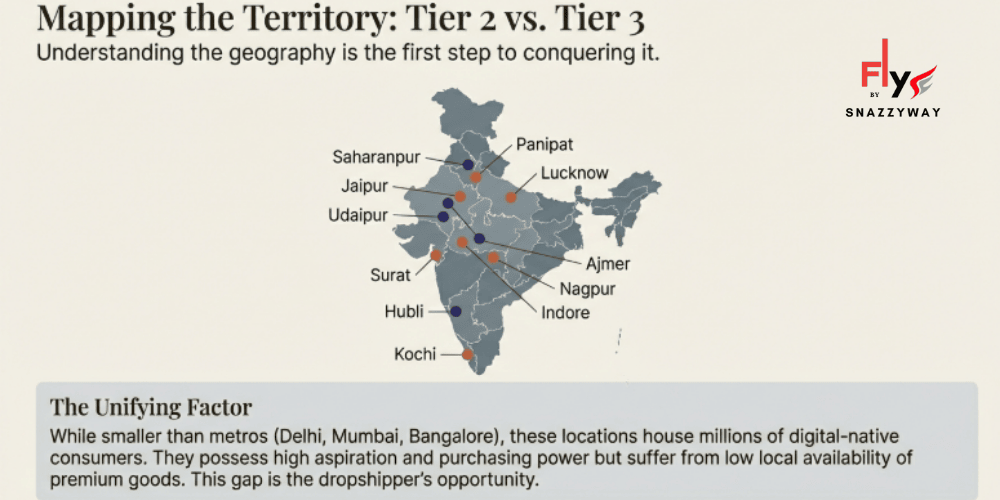
Before we go deeper, let’s understand what we mean by Tier 2 and Tier 3 cities:
- Tier 2 cities : Cities like Jaipur, Lucknow, Surat, Nagpur, Indore, Kochi.
- Tier 3 cities : Smaller towns like Saharanpur, Udaipur, Hubli, Panipat, Ajmer.
These places may not be as big as metros, but they have millions of people shopping online, thanks to smartphones and affordable internet.
Why Focus on Dropshipping in Tier 2 and Tier 3 Cities?
Here’s why you should pay attention to these cities:
1. Growing Online Buyers
People in small cities are shopping online more than ever. They’re looking for good-quality products at affordable prices — but don’t have access to many local stores.
2. Less Competition
Most online sellers target metros. If you focus on Tier 2 and Tier 3 areas, you face less competition and build a strong customer base.
3. COD Preference
Many customers in these cities prefer Cash on Delivery (COD) . Good dropshipping suppliers like Snazzyway support COD, making it easier to sell. Offering COD increases trust among first-time buyers, which is why Cash on Delivery in Indian dropshipping remains critical for Tier-2 and Tier-3 success.
4. Lower Marketing Costs
Ads and promotions cost less in these areas. You can run WhatsApp, Instagram, or Facebook ads with small budgets and still reach thousands of potential customers.
For smaller cities, local sourcing usually performs better than imports, which is why understanding Indian vs international dropshipping is important before scaling.
⚖️ Pros & Cons of Dropshipping in Tier-2 and Tier-3 Cities (2026 Reality)
✅ Pros
-
Lower competition compared to metro markets
Many sellers still ignore Tier-2 and Tier-3 keyword intent.
-
COD continues to dominate buyer trust
Especially for first-time and semi-digital buyers.
-
High repeat purchase potential
Once trust is established, loyalty is strong.
-
Lower advertising costs
CPCs and CPMs remain cheaper than Tier-1 cities.
❌ Cons (Ground Reality in 2026)
-
RTO risk still exists if COD is unmanaged
OTP confirmation and partial prepaid reduce losses.
-
Delivery delays in deep pin codes
Expectations must be clearly communicated.
-
Brand trust takes time
Social proof and packaging matter more than discounts.
What Products Sell Best in Tier 2 and Tier 3 Cities?
When doing dropshipping in Tier 2 and Tier 3 cities India , it’s important to choose products that fit the lifestyle, preferences, and real needs of customers in these areas. These customers are shopping online because many things are not easily available in local stores.
Here are some of the best-selling product ideas for small cities and towns:
- Garter Lingerie Sets – These are stylish and sexy but rarely available in local lingerie shops. Online sellers can fill this gap.
- Plus Size Lingerie (7XL, 8XL and beyond) – In small towns, women with larger body sizes often struggle to find attractive, comfortable lingerie. Offering extra plus-size options helps you serve an underrepresented market. Successful sellers don’t guess trends — they use data and demand signals to identify profitable dropshipping products before launching ads.
- Imported or premium skincare tools – Items like face rollers, blackhead removers, and LED face masks are still uncommon locally.
When you offer something hard to find offline , people are more likely to order from your online store.
If you’re unsure where to start, exploring the best products for dropshipping in India can help you shortlist categories that already perform well in non-metro markets.
Choosing the Right Dropshipping Supplier for Small Cities

Your business success depends a lot on your dropshipping supplier. When choosing a supplier for Tier 2 and Tier 3 city customers , look for:
- Fast delivery across India
- COD support
- Affordable product range
- Good packaging
- White-label option (so you can sell under your own brand name) Suppliers that offer a white-label dropshipping option help build trust faster in Tier-2 and Tier-3 cities by allowing sellers to use their own brand name and packaging
How to Start Dropshipping in Tier 2 and Tier 3 Cities

Before choosing a niche or products, it’s important to understand how the Snazzyway dropshipping model works , especially when serving customers in Tier-2 and Tier-3 cities.
You don’t need a big budget or warehouse to start. Many beginners from smaller towns also explore dropshipping without GST in India , depending on their business model and revenue stage.Here’s a simple step-by-step guide:
Step 1: Choose Your Niche
Pick a profitable dropshipping niche
Step 2: Find a Supplier
Work with a reliable Indian dropshipping supplier that ships across India and supports COD.
Step 3: Create a Simple Store
Use platforms like Shopify, WooCommerce, or even marketplaces like Amazon. For beginners, dropshipping on Amazon in India can be a good starting point due to built-in trust and faster conversions in Tier-2 and Tier-3 cities
Sellers looking to build a long-term brand and repeat customers often prefer to start dropshipping with Shopify , especially when targeting Tier-2 and Tier-3 audiences directly.
Step 4: Add Products & Set Your Prices
Add product photos, set your profit margin, and write easy product descriptions in Hindi/English mix if needed.
Step 5: Promote Locally
Run ads targeting Tier 2 and Tier 3 locations. Use local language, festivals, and trends to connect with your audience. Visual platforms like Instagram work especially well in smaller cities, making Instagram dropshipping in India a powerful low-cost acquisition channel.
💡 Snazzyway Insight: 12+ Years of Tier-2 & Tier-3 Experience
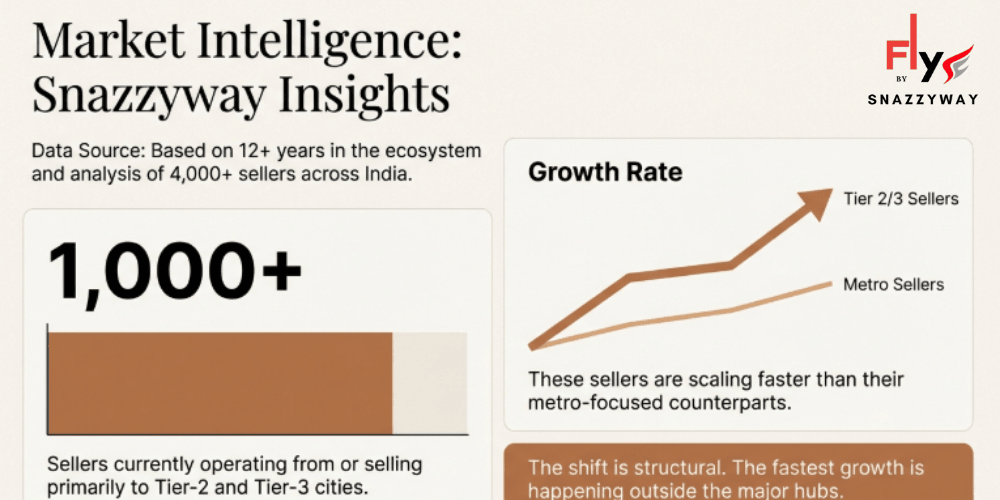
With 12+ years in the Indian dropshipping ecosystem , Snazzyway has worked with 4,000+ sellers across India .
What stands out in 2026 is this 👇
Over 1,000 of these sellers operate from or primarily sell to Tier-2 and Tier-3 cities — and many have scaled faster than metro-focused sellers.
📊 Real Growth Example: French Daina
French Daina is a brand that used Snazzyway’s dropshipping services to sell over 20,000 lingerie gift boxes , many of which were shipped to Tier 2 cities. With COD and branded packaging, they built trust and repeat customers — without holding any inventory!
📦 2025 Growth Highlights:
- Sold 20,000+ lingerie gift boxes
- Significant demand from Tier-2 cities
- Used COD + branded packaging to build buyer confidence
- Created repeat customers without warehouse risk
Final Thoughts: The Future is Bharat
Tier 2 and Tier 3 cities are the future of Indian ecommerce . People there are ready to shop — they just need access to good products and trusted delivery. With the right strategy and supplier, dropshipping in Tier 2 and Tier 3 cities India can help you build a successful online business in 2025 and beyond.
✅ Conclusion: Is Dropshipping in Tier-2 & Tier-3 Cities Worth It in 2026?
Yes — more than ever , if executed correctly.
Tier-2 and Tier-3 cities are now the backbone of India’s eCommerce expansion. Sellers who prioritize trust, COD optimization, transparent delivery communication, and brand credibility are building profitable, sustainable businesses — often faster than metro-centric sellers.
The opportunity in 2026 is no longer speculative. It’s proven, measurable, and scalable.
Your Questions Answered
Yes — Tier-2 and Tier-3 cities in India are now the primary growth engine for Indian dropshipping, and in many categories they are more profitable than metro markets. One seller's data shows Tier-2 and Tier-3 cities driving 60% of total dropshipping orders — with cities like Bhopal, Nagpur, Lucknow, and Coimbatore outperforming Delhi and Mumbai in order volume. The structural advantages for dropshippers targeting these cities are: rapidly rising smartphone penetration and 5G connectivity that is creating millions of first-time online shoppers; limited offline retail access to fashion, lingerie, and premium products that concentrates purchase intent online; lower Facebook and Instagram advertising competition compared to metro audience targeting — resulting in lower cost-per-click and better ROAS; and a growing aspirational middle class willing to spend on quality products at accessible price points. India's dropshipping market is projected to reach US$98.55 billion by 2029, and the next wave of that growth is coming specifically from these non-metro cities. Dropshippers who optimize for Tier-2 and Tier-3 buyers — with COD availability, vernacular language content, and domestic supplier fulfillment — are positioned to capture the most significant untapped opportunity in Indian e-commerce.
The Tier-2 and Tier-3 cities generating the highest dropshipping order volumes in India include Lucknow, Jaipur, Bhopal, Indore, Nagpur, Coimbatore, Surat, Vadodara, Nashik, Rajkot, Madurai, Visakhapatnam, Patna, Agra, and Dehradun. These cities share common characteristics that make them attractive for dropshipping: established courier infrastructure from Delhivery, Blue Dart, and Ecom Express that enables 3–5 day delivery; growing populations of working women aged 20–40 who are active online shoppers for fashion, lingerie, and lifestyle products; first-generation e-commerce buyers who are discovering online shopping through smartphone adoption; and price-sensitive but aspiration-driven consumers who seek quality products unavailable locally. For lingerie and women's fashion specifically — Snazzyway's core dropshipping categories — privacy-driven purchase behavior is even more pronounced in smaller cities than in metros, because local retail options for intimate wear are more limited and the social awkwardness of in-store purchase is higher. This makes Tier-2 and Tier-3 cities structurally stronger markets for lingerie dropshipping than metro areas where offline retail competition is stronger.
Selling dropshipping products effectively to Tier-2 and Tier-3 Indian cities requires four strategic adjustments compared to metro-focused selling. First, price positioning — Tier-2 and Tier-3 buyers have aspirational purchase intent but higher price sensitivity than metro buyers. Products priced at ₹299–₹799 convert significantly better than premium pricing in these markets; bundles that offer more for less — bra set + matching panty at a combined price — perform exceptionally well. Second, COD availability — COD preference is stronger in non-metro cities than metros; offering COD is effectively mandatory for any store targeting these buyers. Pair COD with WhatsApp order confirmation to manage RTO risk. Third, vernacular content — product descriptions, ad copy, and WhatsApp marketing in Hindi (and regional languages like Tamil, Telugu, Marathi, Bengali) significantly outperform English-only content for non-metro audiences. Even basic Hindi captions on Instagram Reels produce measurably higher engagement from Tier-2 and Tier-3 city audiences. Fourth, Facebook and Instagram targeting — use interest-based targeting for fashion and lifestyle combined with geographic targeting of specific Tier-2 cities rather than broad India targeting, which drives metro-heavy traffic and less efficient spend on Tier-2 buyer acquisition.
COD is especially critical for dropshipping in Tier-2 and Tier-3 Indian cities for three reasons that are more pronounced outside metros. First, lower digital payment trust — while UPI has penetrated smaller cities through smartphone adoption, first-time online buyers in non-metro areas have significantly higher anxiety about prepaid e-commerce transactions with unfamiliar brands. COD eliminates this barrier completely, enabling purchase decisions from buyers who would not transact with a prepaid-only store. Second, lower card and credit facility penetration — a meaningful percentage of Tier-2 and Tier-3 buyers do not have credit cards or may not have bank-linked debit cards set up for online transactions; COD serves as the only available payment method for this segment. Third, stronger product-in-hand trust culture — smaller city buyers have a stronger preference for physical inspection before payment, inherited from bazaar and local market shopping culture. Dropshipping stores that offer COD increase their serviceable buyer population in Tier-2 and Tier-3 cities by 30–50% compared to prepaid-only stores — making COD availability a direct revenue multiplier for non-metro market penetration.
Delivery timelines to Tier-2 and Tier-3 cities in India for dropshipping have improved significantly with expanded courier infrastructure, but remain longer than metro delivery by 1–2 days on average. From a supplier fulfillment center like Snazzyway's in Haldwani, Uttarakhand — using courier partners like Delhivery, Blue Dart, Ecom Express, and India Post — delivery to major Tier-2 cities (Lucknow, Jaipur, Indore, Surat, Coimbatore) typically takes 3–5 business days for prepaid orders. Tier-3 cities and smaller towns receive orders in 4–7 business days depending on pin code serviceability. COD orders in remote pin codes can take 5–8 business days. Setting accurate shipping timeline expectations on product pages — rather than promising metro-equivalent 2-day delivery — significantly reduces customer complaints and returns triggered by delivery expectation mismatch. Snazzyway ships pan-India with same-day dispatch for orders placed before 12 PM, providing the fastest possible dispatch start point that minimizes the total transit time to non-metro destinations.
Yes — vernacular language marketing produces measurably better results for Indian dropshippers targeting Tier-2 and Tier-3 cities, and is increasingly becoming a competitive differentiator rather than a nice-to-have. In 2025, India has over 500 million WhatsApp users, and a growing percentage of them consume content primarily in Hindi, Tamil, Telugu, Marathi, Bengali, or Kannada rather than English. Facebook and Instagram Reels in Hindi reach Tier-2 and Tier-3 city audiences at significantly lower CPM (cost per thousand impressions) than English content targeting the same geography — because less advertising competition exists for Hindi-language fashion content. WhatsApp marketing messages in Hindi generate higher open rates and response rates than English messages from Indian fashion sellers targeting non-metro audiences. The practical starting point for dropshippers is adding Hindi product captions and WhatsApp communication alongside English listings — not replacing English entirely — and gradually building Hindi-language Reels content using AI caption generation tools that translate product descriptions accurately without generic machine translation errors. For sellers targeting specific regional markets (Tamil Nadu, Andhra Pradesh, Maharashtra), adding one regional language layer for their primary geographic target produces the highest incremental conversion improvement per language added