Product selection is the single decision that determines whether a dropshipping business works or doesn't. You can have a great website, a solid ad budget, and good customer service — but if you're selling the wrong products, none of it matters.
This guide covers how to actually choose dropshipping products that sell, hold margin, and build a sustainable business. Not generic advice — practical criteria that experienced sellers use at every stage, from first product to scaling.
Why Product Selection Matters More Than Anything Else
Most new dropshippers underestimate this. They pick a product because it looks interesting, or because they saw it trending somewhere, or because a YouTube video said it was hot. Then they wonder why their store isn't converting.
Product selection determines three things that nothing else can fix:
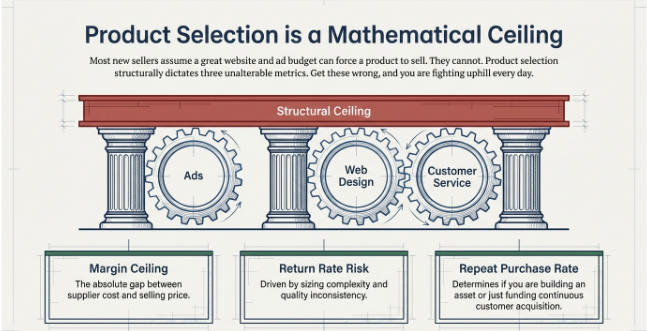
Your margin ceiling. The gap between what you pay the supplier and what the customer pays you is set at the product level. Bad product choice = thin margins regardless of how well you run everything else.
Your return rate. Products with sizing complexity, quality inconsistency, or misleading descriptions drive returns. High return rates destroy profitability faster than almost anything else in dropshipping.
Your repeat purchase rate. Products with natural replacement cycles (innerwear, consumables, seasonal items) generate repeat orders automatically. One-time-purchase products require constant customer acquisition spending.
Get the product right and the rest of the business becomes manageable. Get it wrong and you're fighting uphill every day.
The 6 Criteria That Actually Matter
1. Margin After All Costs — Not Just Markup
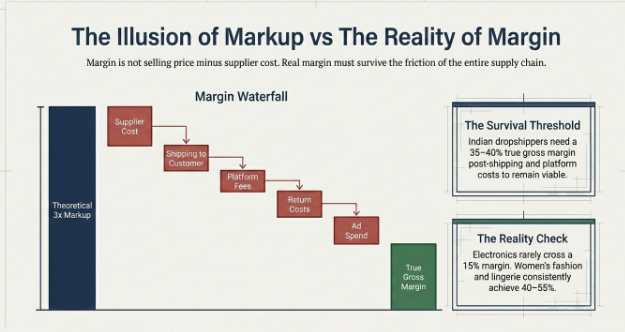
New sellers often calculate margin as selling price minus supplier cost. That's not margin — that's markup. Real margin accounts for:
- Supplier cost
- Shipping to customer
- Platform fees (Shopify subscription, Amazon commission, payment gateway)
- Return handling costs
- Ad spend per order (if running paid traffic)
A product with a 3x markup can still be unprofitable after all costs. A product with a 2x markup in a low-shipping, low-return category can be highly profitable.
Target categories for dropshipping in India typically need a minimum 35–40% gross margin after shipping and platform costs to be worth building around. Women's fashion and lingerie regularly achieve 40–55% in this calculation. Electronics rarely cross 15%.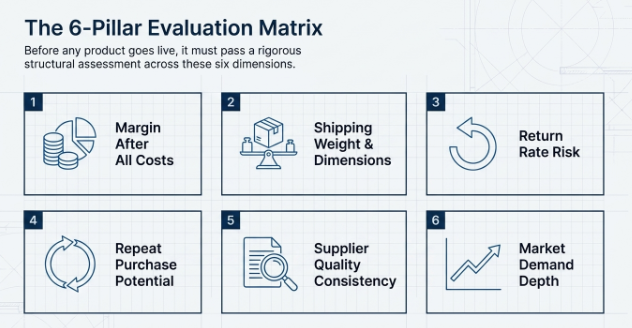
2. Shipping Weight and Dimensions
This one is underappreciated. Lightweight, compact products cost ₹60–₹100 to ship. Heavy or bulky products cost ₹150–₹400+. That difference comes directly out of your margin on every single order.
This is one reason why innerwear, fashion accessories, and jewelry perform so well in Indian dropshipping — they ship at the lowest weight brackets. It's also why furniture, appliances, and large electronics are extremely difficult to make profitable.
Before selecting any product category, calculate the fully loaded shipping cost for your likely order value. If shipping is more than 15–20% of your selling price, the math gets difficult fast.
3. Return Rate Risk
Some product categories have structurally higher return rates than others. Fashion with complex sizing (bras especially), electronics (defects, compatibility issues), and products where color/texture looks different on screen all carry higher return risk.
This doesn't mean avoid these categories — it means go in with a plan. Detailed sizing guides, accurate photography, clear product descriptions, and supplier quality consistency all reduce return rates significantly. Sellers who address this proactively operate in 5–8% return territory. Sellers who ignore it often see 20–30%.
Before choosing a product, ask: what is the most likely reason a customer returns this? Then ask whether you can solve that problem before the order is placed.
4. Repeat Purchase Potential
A customer you've already acquired costs nothing to sell to again — if they have a reason to come back.
Products with natural replacement cycles are the most valuable in dropshipping. Innerwear, nightwear, skincare, and seasonal clothing all have built-in repeat purchase behavior. Customers don't buy one bra and disappear — they come back every few months.
Compare this to a product someone buys once and never needs again. Every single sale requires a new customer acquisition. Customer lifetime value stays flat and acquisition costs compound.
When evaluating a product, ask: will a customer who buys this once have a reason to buy again within 6 months? If yes, you're building something durable. If no, you're on a treadmill.
5. Supplier Quality Consistency
This is where most dropshippers get burned. A supplier looks good on the first sample order — quality is fine, sizing is consistent, packaging is acceptable. Then 3 months in, a batch ships with different fabric, or sizing has shifted, or packaging is damaged. Customer complaints spike. Reviews suffer.
Quality consistency across batches is not something you can verify from a product listing or a price sheet. It requires actual sampling, asking the right questions, and watching the first few orders closely.
Before committing to any product at scale, order product samples from Snazzyway Dropshipping or from whichever supplier you're evaluating. Assess stitching, fabric, color accuracy, and packaging. What you receive in the sample is what your customer will receive — or should be.
6. Market Demand Depth
Trending products are tempting. The sales data looks incredible for a few months, then demand collapses and you're stuck with a store built around something nobody searches for anymore.
Sustainable product selection is built on consistent demand, not spikes. Look for categories where search volume is stable across 12+ months on Google Trends, where there are multiple established players (proving ongoing demand), and where the purchase trigger is functional rather than trend-driven.
Women's innerwear, nightwear, daywear basics — these categories have existed for decades and will continue to exist regardless of what's trending on social media this month. That's the foundation you want to build on.
Snazzyway Dropshipping Insights
Snazzyway Dropshipping has been working with women's fashion and lingerie sellers across India since 2012 — over 12 years of ground-level data from 4,000+ active sellers across 54 product categories. Here's what that experience shows about product selection decisions.
The sellers who succeed fastest pick one sub-category and go deep. Not 10 categories — one. They understand their customer, they know which SKUs move, they know which sizes run out first. Breadth comes later. Depth comes first.
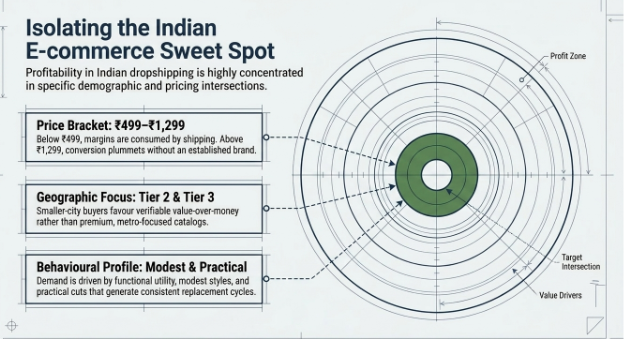
Price point ₹499–₹1,299 is the sweet spot for Indian women's fashion dropshipping. Below ₹499, margins get squeezed to nothing after shipping costs. Above ₹1,299, conversion rates drop unless your brand has established trust. The sellers consistently profitable in women's fashion operate in this range.
The best-performing product decisions are informed by real buyer data, not assumptions. Sellers who look at what their existing customers are asking for — through chat queries, return reasons, repeat purchase patterns — consistently outperform sellers who select products based on gut feel or competitor watching.
Tier 2 and Tier 3 city buyers have specific preferences that differ from metro buyers. The Tier 2 vs Tier 3 City Buyer Behavior Report shows that smaller-city buyers favor modest styles, practical cuts, and value-for-money pricing over premium or fashion-forward pieces. Sellers targeting these markets need product selections calibrated to these preferences — not metro-focused catalogs pushed to a different audience.
Generic products have a ceiling. Branded products don't. Sellers who start on generic products and then transition to white label consistently report 20–35% higher average order values with similar conversion rates. The product doesn't change — the brand positioning does.
Generic vs White Label: How Product Strategy Evolves
Most dropshippers start with generic products — reselling as-is without branding. It's the lowest-barrier entry point and completely valid for validating a niche.
But the ceiling on generic dropshipping is low. You're competing on price with every other reseller carrying the same product. Margins compress over time. Customer loyalty is weak because there's no brand to be loyal to.
White label changes the equation. You sell the same quality product under your own brand name, with your packaging and your label. Customers associate the purchase with your brand, not with a generic product. You can price 20–35% higher. You're building equity.
The profitability comparison between white label and generic dropshipping in the Indian market is clear — white label sellers consistently outperform on margin and customer retention. The recommended path is to validate your product selection on generic first (3–6 months), then transition to white label dropshipping once you know what your customers buy.
Where to Sell: Platform Fit Matters
Product selection and platform selection are connected. The same product performs differently on different platforms.
Shopify gives you full control over presentation, pricing, and brand experience. For fashion categories where visual presentation matters — lingerie, daywear, nightwear — Shopify lets you build a store that feels like a brand rather than a generic reseller. Starting a Shopify dropshipping store is the right path for sellers building around a specific niche with brand-building intent.
Amazon brings enormous organic traffic but demands competitive pricing and strict listing compliance. Products with clear utility, strong reviews, and catalog depth perform best. Dropshipping on Amazon works well for sellers who can compete on catalog breadth or have differentiated products in a defined sub-category.
The platform decision should follow the product decision — not the other way around. Pick your product and niche first, then select the platform that best fits how that product is discovered and purchased.
What the Profitability Data Shows
The India Women and Fashion Dropshipping Seller Profitability Benchmark Report provides a clear picture of which product categories actually deliver profitability for Indian dropshippers.
Key findings relevant to product selection:
Lingerie and innerwear-focused sellers rank among the highest for gross margin percentage — consistently above general fashion and significantly above accessories or electronics. The combination of lightweight shipping, strong repeat purchase behavior, and manufacturer-direct pricing creates a margin structure that's hard to match in other categories.
Seller profitability correlates more strongly with supplier relationship quality than with ad spend. Sellers working with consistent, reliable suppliers outperform higher-spending sellers on inconsistent supply chains. This validates the point made earlier — supplier quality consistency is a core product selection criterion, not a secondary concern.
How to Evaluate a Supplier Before Committing
Supplier evaluation is product evaluation. The two cannot be separated.
Before building your store around any product category, run this checklist on your supplier:
Order samples first. Never commit to a catalog you haven't physically seen. Check fabric quality, stitching, color accuracy versus product photos, and packaging integrity.
Ask about batch consistency. How do they ensure sizing and quality stays consistent across production batches? What's their QC process? Suppliers who can answer this specifically are more trustworthy than those who give vague assurances.
Check fulfillment speed. What's the average dispatch time? What happens during high-demand periods like festivals? Slow fulfillment kills customer satisfaction regardless of product quality.
Understand their return policy. What happens when a customer receives a defective or wrong item? A supplier with a clear, fair return/replacement policy is a genuine business partner. One without is a risk.
Look at how long they've been operating. A supplier with 5+ years in the market and verifiable seller relationships is fundamentally lower risk than a newer operation. When comparing your supplier options, the Snazzyway Dropshipping vs other suppliers comparison page gives a detailed breakdown of what to look for across key evaluation parameters.
Products to Approach with Caution
Not every category is a good dropshipping candidate. A few worth flagging:
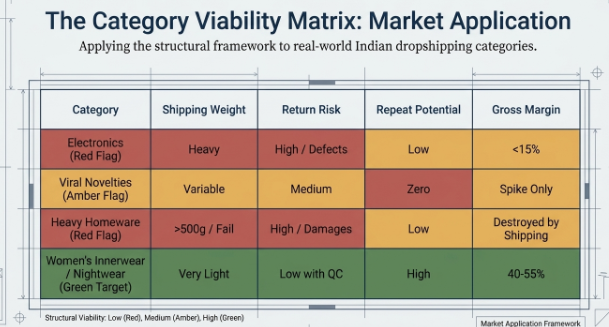
Electronics. Low margins, high return rates, technical support expectations, and warranty complications make electronics one of the worst categories for dropshipping in India. The numbers rarely work.
Heavy or bulky items. Shipping costs destroy margin. Unless you have a hyper-local fulfillment solution, avoid categories where the product weighs more than 500g or exceeds standard courier dimensions.
Highly trend-dependent products. Anything that's popular because of a single viral moment is a short-term play at best. Build around categories with 12-month demand stability, not 6-week spikes.
Counterfeit-risk categories. Branded goods, luxury replicas, and similar categories carry legal risk and platform removal risk. Not worth it regardless of the apparent margin.
About Snazzyway Dropshipping
Snazzyway Dropshipping has been operating since 2012 with a production facility in Haldwani, Uttarakhand, and works with 4,000+ active sellers across India. As India's dedicated B2B women's fashion and lingerie dropshipping platform, the direct manufacturing model means sellers get manufacturer-direct pricing with no middlemen — which is what makes the margin benchmarks cited in this post achievable in practice.
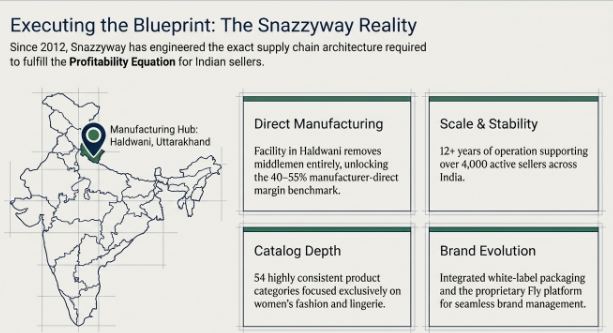
The catalog covers 54 product categories with consistent sizing, branded packaging options, and the Fly platform for order and catalog management. For sellers evaluating product categories and supplier options, the catalog and platform give a practical ground-level view of what manufacturer-direct dropshipping looks like at scale.
Frequently Asked Questions
What is the most important factor when choosing dropshipping products?
Gross margin after all costs — supplier price, shipping, platform fees, and return handling. A product that looks profitable on markup alone can be unprofitable in practice. Always calculate the fully loaded margin before committing to a category.
How do I know if a product has enough demand to build a store around?
Check Google Trends for 12+ months of search history. Stable, consistent search volume is a better signal than a recent spike. Also look for multiple established sellers in the category — competition proves ongoing demand, not just a trend.
Should I start with one product or many products?
Start focused. One sub-category, 15–25 SKUs that you understand deeply. Sellers who go broad early often struggle with inconsistent supplier quality, fragmented customer profiles, and diluted brand identity. Depth first, breadth later.
What's the difference between generic and white label dropshipping products?
Generic means reselling the supplier's product as-is. White label means selling the same product under your own brand name with your label and packaging. White label typically allows 20–35% higher pricing and builds brand equity. Most successful sellers start generic to validate demand, then transition to white label.
How do I vet a dropshipping supplier before committing?
Order physical samples, check batch consistency, verify dispatch times, understand their return/replacement policy, and look at how long they've been operating with verifiable seller relationships. Never commit to a catalog you haven't seen in person.
Which platform is better for dropshipping — Shopify or Amazon?
Both serve different purposes. Shopify gives brand control and higher margins. Amazon gives traffic volume but lower margins and stricter requirements. Most serious sellers use both — Amazon for discovery, Shopify for brand-building and retention.
Is women's fashion a good category for dropshipping in India in 2026?
Yes. Women's fashion — particularly innerwear, lingerie, and nightwear — consistently delivers the strongest margin-to-return-rate ratios in Indian dropshipping. The category has stable year-round demand, strong repeat purchase behavior, and manufacturer-direct sourcing options that create real pricing advantages.
How many SKUs should I launch with as a new dropshipper?
15–25 SKUs in a focused sub-category is the right starting point. This is enough variety to serve different preferences without overextending your catalog management, supplier relationships, or marketing focus.