Lingerie is one of those product categories that comes up in almost every "best dropshipping niches" conversation. And for good reason — it sells year-round, carries strong margins, and has a loyal repeat-buyer base.
But is it actually profitable for dropshippers? Or does the theory look better than the reality?
This post breaks it down clearly — the real numbers, the real challenges, and what sellers actually need to know before picking lingerie as their dropshipping niche.
What Makes Lingerie Different from Other Dropshipping Niches
Most fashion categories follow seasonal demand cycles. Lingerie doesn't — not to the same degree. Women buy innerwear, nightwear, and intimate apparel throughout the year. Gifting spikes around Valentine's Day and anniversaries. Festive season pushes nightwear and lounge sets. Everyday bras and panties move steadily regardless of the calendar.
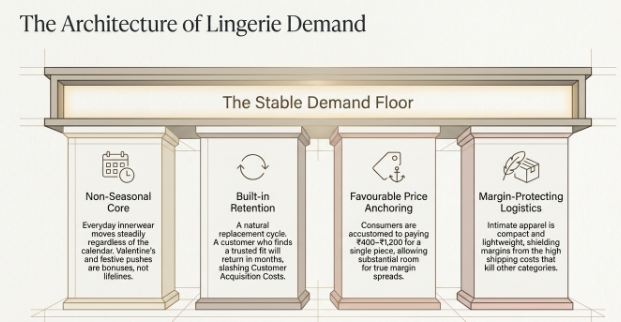
This gives lingerie a significant advantage over trend-driven categories like outerwear or occasion wear. The demand floor is stable.
A few other things make lingerie stand out as a dropshipping category:
Repeat purchase behavior is built in. Innerwear has a natural replacement cycle. A customer who buys bras this month will likely need new ones in a few months. This makes customer retention and repeat orders easier to achieve than in one-time-purchase categories.
Price anchoring is favorable. Customers are accustomed to paying ₹400–₹1,200 for a single innerwear piece. For dropshippers sourcing at manufacturer-direct prices, this creates room for genuine margin — not the paper-thin spreads common in electronics or accessories.
The product ships light. Lingerie is compact and lightweight. Shipping costs stay low, which directly protects margin. This is not a trivial point — many dropshipping categories get killed by logistics costs.
The Market Size: Why Lingerie Attracts Sellers
India's innerwear and intimate apparel market is large and growing. The organized segment alone is estimated to cross ₹50,000 crore in the coming years, with online penetration accelerating rapidly. Tier 2 and Tier 3 cities — historically underserved by local stores — are now active online buyers of women's innerwear.
This is not a niche with a ceiling problem. The demand is there, and it's still not fully captured online.
Globally, the picture is similar. Women's intimate apparel is a multi-billion dollar category that has consistently grown across markets. International dropshippers sourcing from India often find that Indian manufacturing quality at global price points creates strong competitive advantage.
Real Profit Margins: What Sellers Actually Make
Let's get specific.
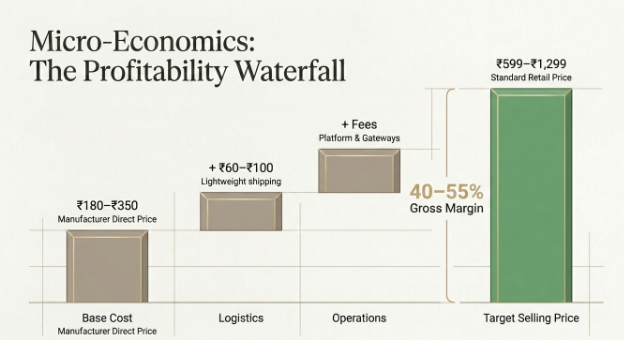
A standard bra set sourced at manufacturer-direct prices in India might cost ₹180–₹350 depending on the design and fabric. Retail selling price for the same product typically ranges from ₹599 to ₹1,299 on most Shopify stores or Amazon listings.
After shipping (typically ₹60–₹100 for lightweight items), platform fees, and payment gateway charges, a well-run lingerie dropshipping store can achieve 40–55% gross margins on most SKUs.
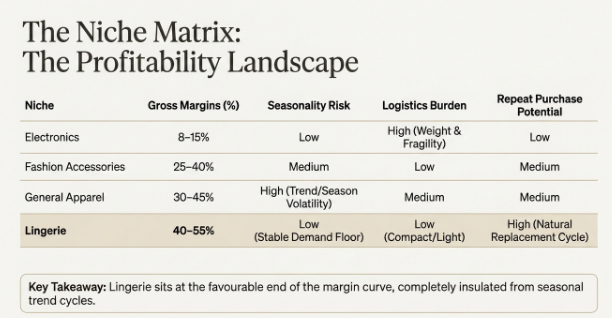
Compare this to:
- Fashion accessories: 25–40% margins, high competition
- Electronics: 8–15% margins, high return rates
- General apparel: 30–45% margins, seasonal volatility
Lingerie sits at the favorable end of the margin curve — especially when sourced directly from a manufacturer or a supplier with a direct manufacturing link.
The margin picture improves further when sellers move toward white label or private label models, where they can brand the product and command premium pricing without competing purely on price.
Snazzyway Dropshipping Insights
Snazzyway Dropshipping has been working directly with women's fashion and lingerie sellers across India since 2012 — over 12 years of ground-level data from 4,000+ active sellers across 54 product categories.
Here's what that experience actually shows:
Lingerie is the highest-retention category we see. Sellers who start with lingerie tend to stay with it. The repeat order rate from their customers is significantly higher than in daywear or occasion wear. Once a customer finds a fit and brand they trust, they come back.
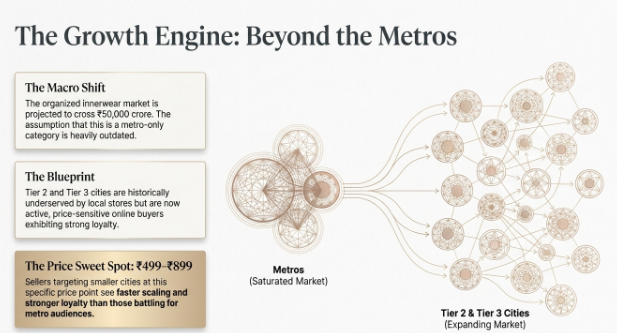
Tier 2 and Tier 3 cities are the growth engine right now. The assumption that lingerie is a metro-only category is outdated. Smaller city buyers are now active, price-sensitive, and show strong loyalty when delivery is reliable. Sellers targeting these markets with the right price points — typically ₹499–₹899 — see faster scaling than those focused on metro audiences.
Sizing consistency is the #1 seller complaint — and the #1 differentiator. Sellers who work with suppliers that maintain consistent sizing across batches have dramatically lower return rates. This is where supplier selection becomes a competitive advantage, not just a logistics decision.
Nightwear is the easiest entry point. For new sellers who are nervous about the sizing complexity of bras, nightwear (loungewear, sleep sets, maxi nightgowns) offers similar margins without the fit-related return risk. Many successful lingerie dropshippers started with nightwear and expanded into innerwear once they understood their customer base.
Catalog depth matters more than catalog width. Sellers with 20 well-chosen SKUs that they understand deeply outperform sellers with 200 SKUs they've never seen. Quality over volume — in product selection and in supplier relationships.
Challenges That Sellers Actually Face (And How to Handle Them)
1. Sizing Returns
This is the most common operational challenge in lingerie dropshipping. Bras, in particular, have a complex sizing structure (band size + cup size), and customers frequently order the wrong size.
The fix is not complicated, but it requires action: publish a clear, detailed sizing guide on every product page. Use your supplier's actual measurements — not generic size charts. Sellers who do this see return rates drop significantly within the first few months.
2. Product Photography and Presentation
Lingerie is a visual category. Poor product imagery kills conversion regardless of how good the product is. This is worth investing in — either request high-quality images from your supplier or consider ordering samples and shooting your own.
3. Supplier Reliability
The lingerie category has more fly-by-night suppliers than most. Quality inconsistency, sizing variation between batches, and poor packaging are common issues with low-quality suppliers. Working with an established supplier who has auditable quality control processes is not optional in this category — it's the difference between a functioning business and a refund nightmare.
Before committing to any supplier, order product samples. Evaluate stitching quality, fabric feel, elasticity, color accuracy, and packaging. What you receive is what your customer will receive.
→ Order product samples from Snazzyway Dropshipping before you commit to any catalog.
4. Platform Policy Compliance
Selling lingerie on marketplaces like Amazon requires attention to category-specific guidelines around imagery, product descriptions, and listing compliance. Shopify gives more flexibility, but store design and presentation still need to reflect a trustworthy brand rather than a generic reseller.
Platform Strategy: Where to Sell Lingerie
Shopify
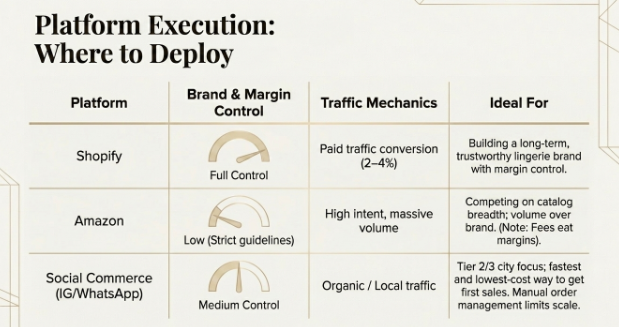
Shopify gives you full control over branding, photography, and customer experience. For lingerie, this matters — customers buying intimate apparel want to feel they're buying from a brand, not a random reseller. A well-designed Shopify store with good product photography and a sizing guide can convert at 2–4% from paid traffic, which is strong for fashion.
Starting a Shopify dropshipping store is the recommended path for sellers who want to build a long-term lingerie brand with margin control.
Amazon
Amazon's customer base is enormous and has strong purchase intent. The tradeoff is tighter margins (Amazon fees eat into profit), stricter listing requirements, and more competition on price. It works best for sellers who can compete on catalog breadth or who have differentiated products.
Dropshipping on Amazon requires attention to Amazon's specific lingerie category guidelines and consistent fulfillment performance to maintain seller health.
Social Commerce (Instagram, WhatsApp, Facebook)
A significant portion of lingerie dropshipping in India happens through social commerce — Instagram stores, WhatsApp broadcast groups, and Facebook Shop. For sellers in Tier 2 and Tier 3 cities, this is often the fastest and lowest-cost way to get first sales. The tradeoff is lower scalability and manual order management.
White Label vs Generic: Which Approach Works Better for Lingerie
Generic dropshipping (reselling as-is without branding) is the entry point for most sellers. It's the lowest barrier — no minimum order for branding, no upfront investment, start immediately.
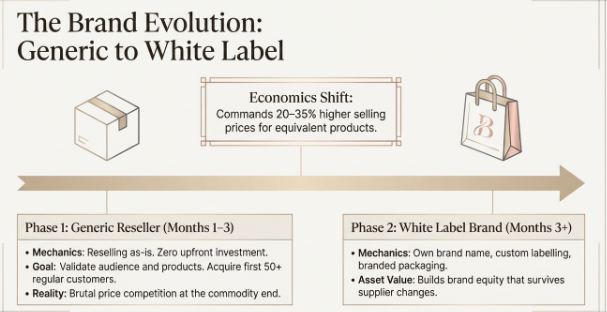
But the ceiling is lower. Generic resellers compete on price, and price competition in lingerie is brutal at the commodity end of the market.
White label changes the economics. When you sell lingerie under your own brand name — with your label, your packaging, your brand story — you command 20–35% higher selling prices for equivalent products. More importantly, you're building an asset: brand equity that survives if your supplier changes.
The profitability difference between white label and generic dropshipping is well-documented in the Indian market. For serious sellers, white label is the natural progression — usually after 3–6 months of validating products and audience on the generic model.
Snazzyway Dropshipping offers both paths. Generic dropshipping to get started, and a full white label dropshipping program for sellers ready to build a brand.
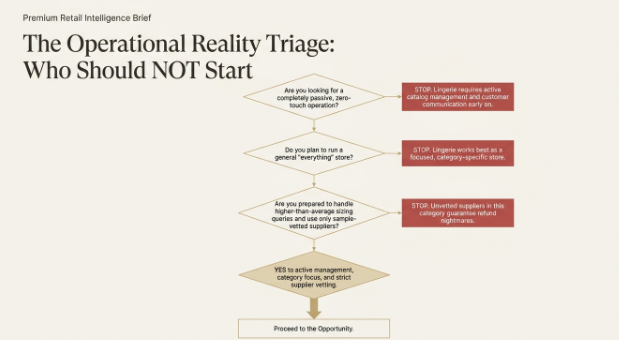
Who Should NOT Start with Lingerie Dropshipping
Honesty matters here. Lingerie is not the right starting point for everyone.
Skip lingerie if:
- You're not prepared to handle returns and sizing queries. Customer service load is higher than in most categories.
- You want to run a general store covering multiple unrelated niches. Lingerie works best as a focused, category-specific store.
- You're looking for a completely passive, zero-touch operation. It requires active catalog management and customer communication, especially early on.
- You plan to use a supplier you haven't vetted with samples.
How Indian Seller Behavior Shapes the Lingerie Opportunity
India's women's fashion dropshipping market has specific characteristics that affect how the lingerie opportunity plays out at ground level.
The India Women and Fashion Dropshipping Seller Profitability Benchmark Report shows that lingerie and innerwear-focused sellers consistently rank among the highest for gross margin percentage — above general fashion and significantly above accessories.
The report also shows that seller profitability correlates strongly with supplier relationship quality, not with advertising spend. Sellers who invest in a reliable supplier and maintain consistent catalog quality outperform higher-spending sellers who work with inconsistent suppliers.
Buyer behavior data from Tier 2 and Tier 3 cities further reinforces the opportunity. The Tier 2 vs Tier 3 City Buyer Behavior Report shows that smaller-city buyers have strong purchase intent in the ₹499–₹899 price range for women's innerwear — a range that maps well to healthy dropshipping margins.
How to Start: The Practical Path
- Pick your platform. Shopify for brand-building; Amazon for volume; social commerce for fast first sales.
- Choose your starting sub-category. Nightwear for simplicity, bra sets for margin, panties for volume.
- Vet your supplier. Order samples. Check sizing consistency. Check packaging. Check communication response time.
- Build your store properly. Invest in product images and sizing guides. Don't skip this.
- Start generic, plan for white label. Validate your audience first. Move to white label when you have 50+ regular customers and know what they buy.
- Learn your metrics. Track return rate, repeat order rate, and gross margin per SKU from month one.
About Snazzyway Dropshipping
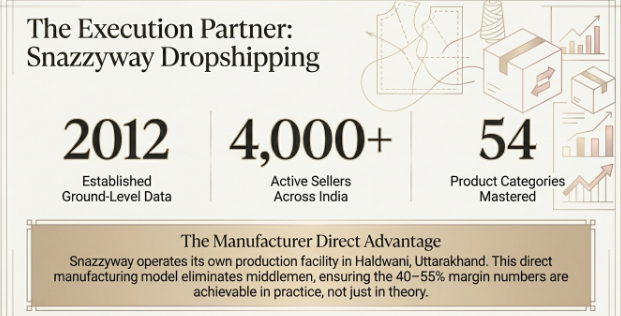
Snazzyway Dropshipping has been operating since 2012 with a production facility in Haldwani, Uttarakhand, and works with 4,000+ active sellers across India. The direct manufacturing model means sellers get manufacturer-direct pricing without middlemen — which is what makes the margin numbers cited in this post achievable in practice, not just in theory.
The Snazzyway Dropshipping catalog covers 54 product categories in women's fashion and lingerie, with consistent sizing, branded packaging options, and a dedicated platform (Fly) for order and catalog management.
Frequently Asked Questions
Is lingerie a good niche for beginner dropshippers in India?
Yes, with the right supplier. Lingerie offers strong margins and repeat purchase behavior, but beginners should start with a focused sub-category (nightwear or panties) to manage the learning curve before expanding into full innerwear ranges.
What profit margin can I expect from lingerie dropshipping?
Most sellers working with a direct manufacturer achieve gross margins of 40–55% on lingerie SKUs. Margins depend heavily on sourcing price, shipping costs, and whether you're selling generic or under a white label brand.
How do I handle returns and sizing issues in lingerie dropshipping?
Publish detailed sizing guides with actual measurements on every product page. Use your supplier's real size data, not generic charts. This single step typically reduces sizing-related returns by 30–50% for new sellers.
Is it better to sell lingerie on Shopify or Amazon?
Shopify gives higher margins and brand control; Amazon gives higher traffic. Most serious sellers use both — Amazon for discovery and volume, Shopify for brand-building and margin protection. Start with whichever platform you're more comfortable with.
What is white label lingerie dropshipping?
White label means you sell the supplier's product under your own brand name, with your label and packaging. It allows you to charge 20–35% more than generic resellers and builds brand equity over time. It's the recommended path for sellers who plan to be in lingerie dropshipping long-term.
Can I dropship lingerie internationally from India?
Yes. Indian manufacturing quality is globally competitive, and costs are lower than most international alternatives. International shipping adds logistics complexity, but sellers targeting markets in the Middle East, Southeast Asia, or the UK find the unit economics work well.
How many SKUs should I start with in lingerie dropshipping?
Start with 15–25 SKUs in a focused sub-category. Understand those products deeply before expanding. Sellers with 20 well-chosen SKUs consistently outperform those with 200 randomly selected ones.