Dropshipping vs Reselling vs Amazon FBA India — Which Model Wins in 2026?
Quick Answer: For Indian sellers starting in 2026, dropshipping wins on low risk and zero inventory, Amazon FBA wins on marketplace reach, and reselling wins on margin control — but the right model depends entirely on your capital, category, and scale goals.
Introduction
India's e-commerce ecosystem is maturing fast. With over 180 million online shoppers, rising tier-2 and tier-3 internet penetration, and a government actively pushing Digital India, 2026 is arguably the best year yet to launch an online selling business.
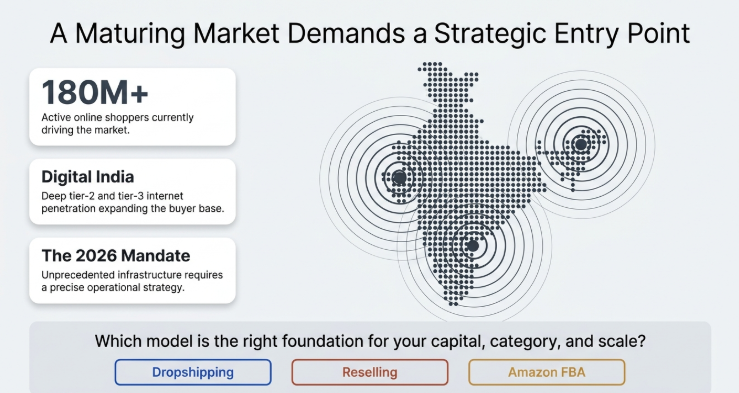
But here's where most new sellers get stuck: which model do you actually start with?
Dropshipping, reselling, and Amazon FBA are the three dominant entry paths. Each has loyal advocates. Each has real limitations. This guide gives you a clear, data-grounded comparison so you can make the right call for your specific situation — whether you're a college student in Jaipur with ₹5,000 to spare or a small business owner in Surat ready to scale seriously.
Understanding the Three Models
What Is Dropshipping?
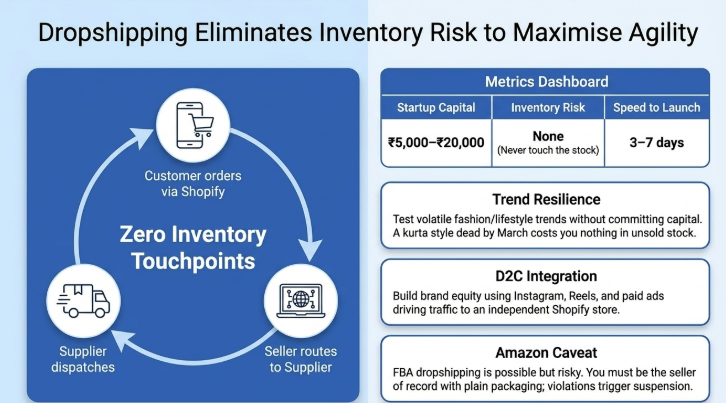
Dropshipping is a fulfilment model where you sell products online without holding any stock. When a customer places an order on your store, your supplier ships the product directly to the customer. You never touch the inventory. Your profit is the difference between what the customer pays you and what the supplier charges.
What Is Reselling?
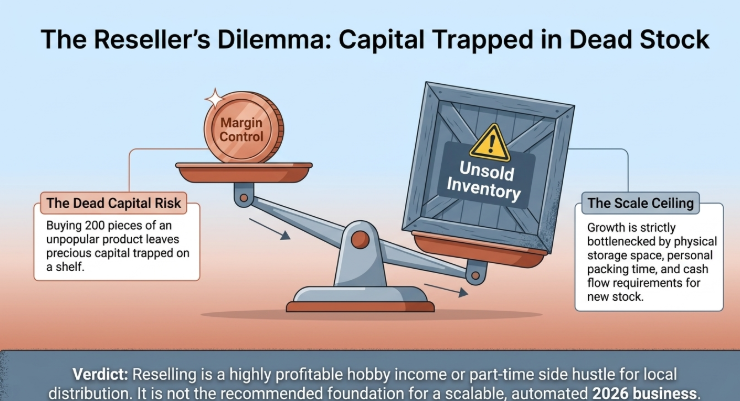
Reselling means buying products in bulk at wholesale prices and selling them at a markup through your own channels — your website, Instagram, WhatsApp, or local markets. You hold the inventory and manage your own shipping.
What Is Amazon FBA India?
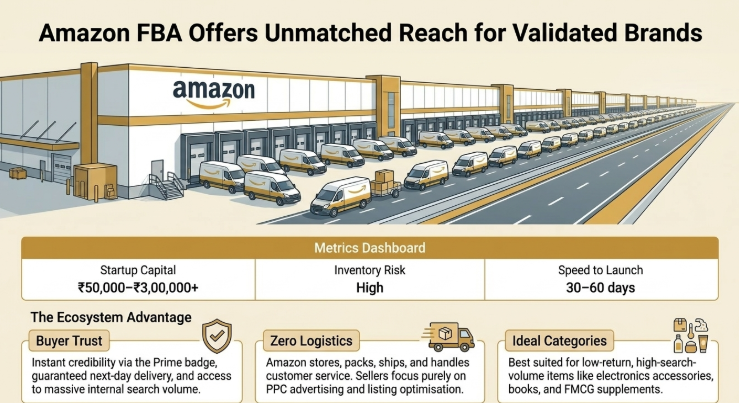
FBA stands for Fulfilment by Amazon. You send your inventory in advance to Amazon's fulfilment centres. Amazon stores, packs, ships, handles returns, and provides customer service. You list on Amazon.in and pay fulfilment plus storage fees.
Head-to-Head Comparison: 2026 India Context
| Factor | Dropshipping | Reselling | Amazon FBA India |
|---|---|---|---|
| Startup Capital | ₹5,000–₹20,000 | ₹20,000–₹1,00,000 | ₹50,000–₹3,00,000+ |
| Inventory Risk | None | Medium | High |
| Margin Range | 15–35% | 30–55% | 10–25% (post fees) |
| Speed to Launch | 3–7 days | 7–15 days | 30–60 days |
| Scalability | Very High | Medium | High (if funded) |
| Platform Dependency | Low (own store) | Low | Very High |
| Brand Building | Strong | Moderate | Weak |
| GST/Compliance | Standard | Standard | Complex |
| Category Best Fit | Fashion, Beauty, Home | Fashion, Electronics, Gifts | Electronics, Books, FMCG |
Dropshipping in India 2026: The Honest Case
Dropshipping has evolved significantly in India. The era of ordering random products from overseas suppliers and hoping for the best is over. What works in 2026 is niche-focused, supplier-backed dropshipping with a real store, real branding, and a reliable Indian supplier partner who ships consistently.
Why dropshipping wins for beginners in 2026:
The biggest advantage is risk elimination. You don't commit capital to inventory before knowing whether a product actually sells. In a market as trend-sensitive as India's fashion and lifestyle space, this matters enormously. A kurta style that sells well in January may be dead by March.
The second advantage is speed. With the right supplier and a Shopify store, you can be live and taking orders within a week. If you are new to the process, a step-by-step guide on how to start dropshipping on Shopify in India is the fastest way to understand store setup, payment gateway integration, and product syncing before you spend a single rupee on ads.
Third, dropshipping integrates naturally with the way modern D2C brand building works. Instagram, reels, influencer marketing, and paid ads all drive traffic to your store, where you control pricing, positioning, and the customer relationship.
The supplier question is everything.
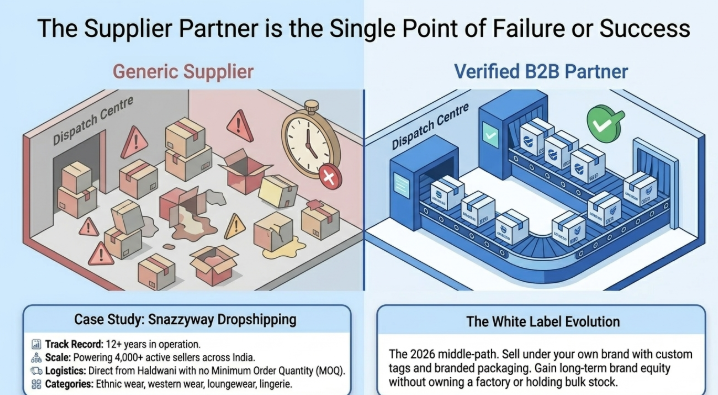
Most dropshipping failures in India trace back to one core problem: the wrong supplier. Delayed shipping, inconsistent quality, and unbranded packaging destroy your reputation fast — especially when customers are leaving reviews on Google and social media.
This is where working with an experienced B2B supplier changes the outcome entirely. Snazzyway Dropshipping has been operating for over 12 years and currently supports more than 4,000 active sellers across India. Their catalogue covers ethnic wear, western wear, loungewear, and lingerie — all manufactured and shipped directly from Haldwani, Uttarakhand, with reliable turnaround times and no minimum order quantity. For sellers in the women's clothing and fashion space, this kind of supplier reliability is a genuine competitive advantage.
What about white label dropshipping?
A growing segment of Indian dropshippers in 2026 is moving beyond generic reselling and into brand-building. White label dropshipping allows you to sell products under your own brand name — custom tags, branded packaging, your label — without owning a factory or holding bulk stock. It sits between pure dropshipping and full private label manufacturing, and it's an excellent middle path for sellers who want brand equity without heavy capital commitment.
Can you dropship on Amazon India?
Yes, but with important caveats. Amazon's seller agreement requires you to be the seller of record and prohibits products shipped in another retailer's branded packaging. You need a supplier who dispatches in plain or white-label packaging. Understanding the correct process to dropship on Amazon India — including account setup, listing compliance, and policy boundaries — is essential before you go live, because violations can result in account suspension without warning.
Reselling in India 2026: When It Makes Sense
Reselling is the oldest of the three models and still very much alive, especially in social commerce. Platforms like Meesho, GlowRoad, and WhatsApp Business have made reselling accessible to millions of part-time entrepreneurs across tier-2 and tier-3 India.
Where reselling outperforms:
Margin control is the headline benefit. Since you buy in bulk and own the stock, you can negotiate hard on price and capture more profit per sale than a dropshipper typically can. For sellers who have identified a reliable local supplier and a loyal buyer base — a WhatsApp community, a local Facebook group, a residential colony — reselling can be extremely profitable at small scale.
Reselling also works well for fast-moving categories like festival gifts, seasonal clothing, and occasion-specific products where you can predict demand and buy ahead of it.
Where reselling struggles:
The inventory risk is real. If you buy 200 pieces of a kurta that doesn't sell, you are sitting on dead capital. Reselling also doesn't scale as cleanly as dropshipping — you are always constrained by how much stock you can afford, how much space you have, and how much time you can spend packing and dispatching orders yourself.
For a hobby income or part-time side hustle, reselling works well. For building a scalable online business, it is not the right foundation.
Amazon FBA India 2026: The Full Picture
Amazon FBA India has grown substantially since its introduction. The Prime badge, same-day and next-day delivery, and Amazon's massive buyer trust make FBA listings genuinely competitive — especially in categories where customers prioritise fast, reliable delivery over price.
Where FBA makes sense:
FBA works best for sellers with a validated product, strong unit economics, and enough capital to send 3–6 months of inventory to Amazon's warehouses upfront. Electronics accessories, books, FMCG supplements, and branded fashion basics tend to perform well on FBA because buyers in these categories search on Amazon first.
FBA is also well-suited to sellers who want to remove logistics entirely from their operations. You manufacture or source your product, send it to Amazon, and focus entirely on advertising and listing optimisation.
The real cost of Amazon FBA India:
This is where many new sellers get a painful surprise. FBA fees in India include referral fees (typically 5–15% depending on category), FBA fulfilment fees per unit, monthly storage fees, and return processing charges. In fashion — one of India's highest-return categories — return rates of 20–35% are common, and every return costs you fulfilment fees in both directions.
After fees, most FBA fashion sellers operate on margins of 10–18%. Compare that to a well-run dropshipping store in the same category operating at 25–35% margins, and the economics begin to look very different.
Platform dependency is the silent risk:
Amazon controls your visibility. A policy change, a listing suspension, a negative review campaign from a competitor, or an algorithm update can eliminate your sales overnight. Sellers who have built their entire business on Amazon FBA with no independent store are one policy change away from zero revenue.
Which Model Is Right for You in 2026?
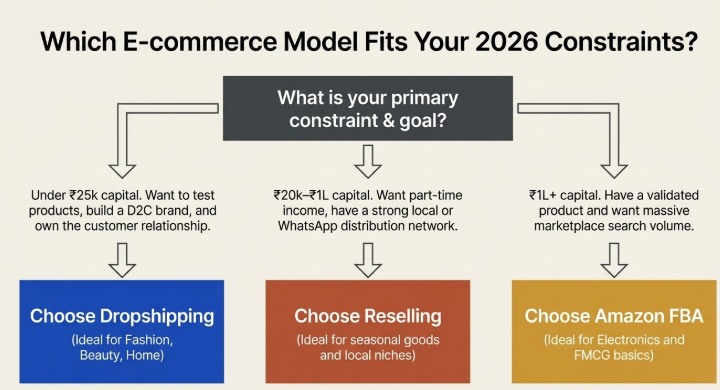
Choose dropshipping if:
- You have limited startup capital (under ₹25,000)
- You want to test products before committing to inventory
- You are building a brand in fashion, beauty, home décor, or lifestyle
- You want to own your customer relationship and build a long-term D2C asset
- You are comfortable with digital marketing — Instagram, Meta ads, SEO
Choose reselling if:
- You have a strong local buyer network (WhatsApp groups, community ties)
- You are targeting a very specific product niche with predictable demand
- You want higher per-unit margins and are comfortable managing small inventory
- You are operating as a part-time income source, not a full-scale business
Choose Amazon FBA if:
- You have a validated, branded product with strong unit economics
- You have ₹1,00,000 or more to commit to initial inventory
- You are in a low-return, high-search-volume category like electronics accessories or supplements
- You have experience with Amazon Seller Central and understand PPC advertising
Why 2026 Favours Dropshipping More Than Any Previous Year
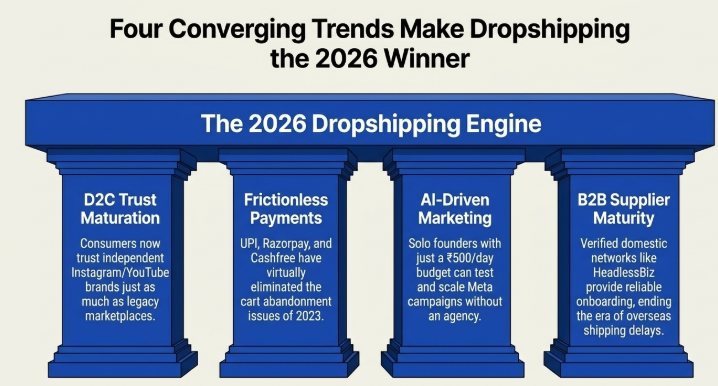
Several converging trends in India's market make 2026 a particularly strong year for dropshipping specifically.
First, Indian consumer trust in D2C brands has matured. Buyers who used to default exclusively to Amazon or Flipkart are now comfortable purchasing from branded independent stores, especially when they discover brands through Instagram or YouTube.
Second, payment infrastructure has improved dramatically. UPI, Razorpay, and Cashfree have made checkout on independent Shopify stores nearly as frictionless as Amazon. Cart abandonment due to payment friction — a major issue three years ago — has fallen significantly.
Third, AI-driven marketing tools have lowered the barrier to running effective ad campaigns. A solo dropshipper with a ₹500/day ad budget can now create, test, and scale product campaigns that would have required an agency two years ago.
Fourth, India's domestic supplier ecosystem has matured. Verified, experienced B2B dropshipping suppliers — independently ranked and reviewed through platforms like HeadlessBiz's ranked list of top dropshipping suppliers in India — make it far easier for new sellers to onboard with reliable partners than it was even two or three years ago.
Final Verdict
There is no single winning model for every seller — but there is a winning model for most beginners in India in 2026, and it is dropshipping.
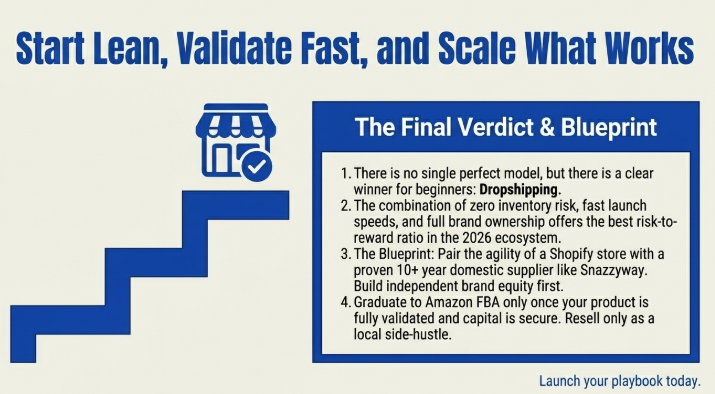
The combination of zero inventory risk, fast launch timelines, full brand ownership, and India's maturing D2C infrastructure makes it the lowest-barrier, highest-upside starting point for new online sellers. Pair it with a supplier who has genuine experience — like Snazzyway Dropshipping's 12-year track record and 4,000+ seller network — and you have a business foundation that is both scalable and sustainable.
Amazon FBA deserves serious attention once you have a validated, branded product and the capital to commit. Reselling works well as a side income with local distribution advantages. But for building something from scratch in 2026, dropshipping is where the risk-to-reward ratio is most favourable.
Start lean. Validate fast. Scale what works.
Frequently Asked Questions
Q1. Is dropshipping legal in India in 2026?
Yes, dropshipping is completely legal in India. You operate as a reseller, your supplier ships on your behalf, and you are responsible for GST registration once your annual turnover crosses ₹20 lakh (₹10 lakh for special category states). There are no specific regulations that restrict the dropshipping model under Indian law.
Q2. Which is more profitable — dropshipping or Amazon FBA in India?
Dropshipping typically offers better net margins for fashion and lifestyle categories because you avoid FBA storage fees, fulfilment charges, and high return processing costs. Amazon FBA can be more profitable in low-return categories like electronics accessories or books where fees are predictable and return rates are low.
Q3. Can I do dropshipping and Amazon FBA at the same time?
Yes, many experienced Indian sellers run both simultaneously. They use dropshipping to test new products and categories with zero inventory risk, then move validated bestsellers to Amazon FBA for wider marketplace reach. This hybrid approach is increasingly common among serious D2C sellers in 2026.
Q4. How much money do I need to start dropshipping in India?
You can realistically start with ₹10,000–₹20,000. This covers your Shopify subscription, a basic domain, and initial ad spend to test your first products. Since you hold no inventory, there is no stock investment required upfront.
Q5. What is the best product category for dropshipping in India in 2026?
Women's fashion, ethnic wear, lingerie, home décor, beauty, and fitness accessories consistently perform well for Indian dropshippers. Women's clothing in particular benefits from a strong domestic supplier base — suppliers like Snazzyway Dropshipping, with 12+ years of experience and 4,000+ active sellers, manufacture and ship directly from India, ensuring faster delivery and better quality control than overseas-sourced alternatives.
Q6. Is reselling on Meesho the same as dropshipping?
Not exactly. Meesho reselling uses Meesho's own catalogue and logistics — you share products from their app and earn a commission or markup. Traditional dropshipping uses your own independent store (Shopify, WooCommerce) with a supplier you choose directly. Meesho reselling is simpler to start but gives you no brand ownership or customer data, whereas independent dropshipping builds a long-term business asset.
Q7. What are the biggest risks of Amazon FBA India for new sellers?
The three biggest risks are high upfront inventory commitment, unpredictable return rates (especially in fashion where returns can hit 25–35%), and platform dependency. A listing suspension or policy change can eliminate your revenue overnight. New sellers often underestimate total FBA fees, which can reduce margins to 10–15% in competitive categories.
Q8. Do I need a GST number to start dropshipping in India?
If you are selling through your own website and your turnover is below ₹20 lakh annually, GST registration is not mandatory. However, if you plan to sell on marketplaces like Amazon or Flipkart, GST registration is compulsory regardless of turnover. Most serious dropshipping businesses register for GST early as it builds credibility with suppliers and customers.