GST on Clothing Dropshipping in India: What Every Reseller Needs to Know
Quick Answer: GST on clothing dropshipping in India depends on the product value — garments priced up to ₹1,000 attract 5% GST, while those above ₹1,000 attract 12%. As a dropshipping reseller, you are responsible for GST compliance on your sales even though your supplier handles physical fulfilment. Understanding this correctly from day one protects you from penalties and keeps your business legally clean.
Introduction
GST compliance is one of the most searched and most misunderstood topics among new clothing dropshippers in India. When you are selling kurtas, lingerie, ethnic wear, or western fashion through your own Shopify store or on a marketplace — and your supplier is shipping directly to your customer — the question of who pays what tax, when, and how, becomes genuinely confusing.
This guide breaks it down completely. Whether you are just starting out or already running an active dropshipping store, understanding GST on clothing dropshipping in India is not optional. It protects your margins, keeps your accounts clean, and ensures you can scale without legal surprises.
India's GST framework has been in place since July 2017, but its application to the dropshipping model — particularly for clothing resellers operating without physical stock — is still something most new sellers figure out the hard way. This guide is designed so you don't have to.
What Is GST and Why Does It Apply to Dropshipping?
GST, or Goods and Services Tax, is a unified indirect tax levied on the supply of goods and services across India. It replaced a fragmented system of central excise duty, VAT, and service tax with a single, destination-based tax structure.
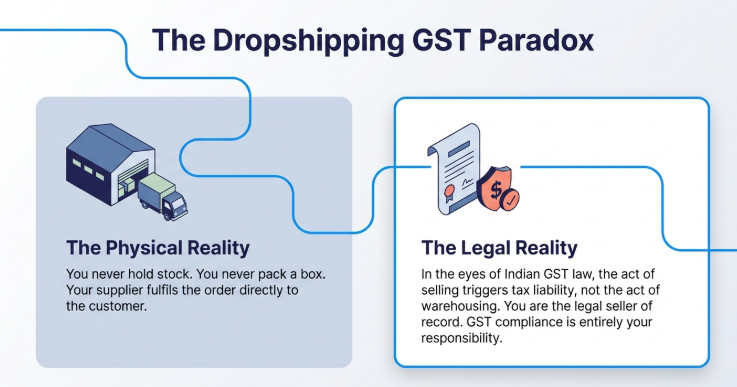
For dropshipping, GST applies because you are engaged in the supply of goods — even though you never physically handle the inventory. In GST law, the act of selling is what triggers tax liability, not the act of warehousing or dispatching. This means that as a dropshipper, you are the seller of record in the eyes of the law, and GST compliance is your responsibility.
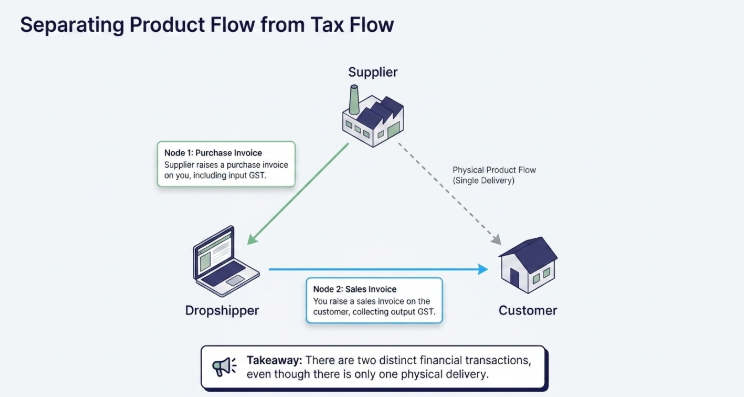
Your supplier also charges GST on the goods they supply to you (or on behalf of you, in a dropshipping arrangement). This creates a two-step GST flow that needs to be understood clearly.
GST Rates on Clothing in India: The Current Structure
As of 2026, GST on readymade garments and clothing in India is structured as follows:
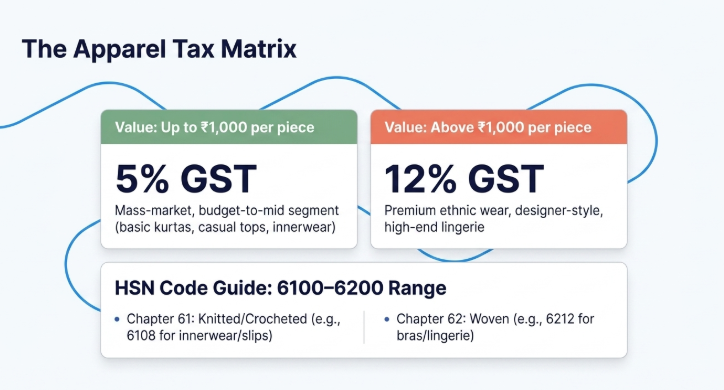
Garments priced up to ₹1,000 per piece — 5% GST
This covers the majority of the mass-market clothing segment including basic kurtas, casual tops, innerwear, leggings, and everyday ethnic wear. Most dropshipping sellers in the budget-to-mid segment operate in this bracket.
Garments priced above ₹1,000 per piece — 12% GST
This applies to premium ethnic wear, designer-style fusion clothing, higher-end lingerie sets, and occasion wear. If your store is positioned in the mid-premium or premium segment, most of your catalogue will fall here.
Important note on fabric and accessories:
Raw fabric attracts 5% GST. Lace, embroidery trims, zippers, and buttons used in garment manufacturing also vary between 5% and 12%. If you are exploring white label or custom manufacturing as part of your dropshipping expansion, these input GST rates affect your supplier's pricing and therefore your purchase cost.
How GST Works in a Dropshipping Transaction
In a standard dropshipping transaction, there are three parties: the end customer, you (the dropshipper/reseller), and your supplier. Understanding how GST flows between these three is critical.
Step 1: Supplier to Dropshipper
Your supplier raises an invoice on you for the goods being dispatched. This invoice includes GST at the applicable rate (5% or 12% depending on the product). This is your purchase invoice and is the basis for claiming Input Tax Credit (ITC).
Step 2: Dropshipper to Customer
You raise a sales invoice on your end customer. This invoice must include GST at the applicable rate on your selling price. You collect this GST from your customer as part of the transaction.
Step 3: GST Filing
The difference between the GST you collected from customers (output tax) and the GST you paid to your supplier (input tax) is your net GST liability. If your output tax exceeds your input tax, you pay the difference to the government. If your input tax is higher in a given period, you carry the credit forward.
This mechanism — Input Tax Credit — is one of the genuine financial advantages of being GST registered even when your turnover is below the mandatory threshold.
GST Registration: When Is It Mandatory for Clothing Dropshippers?
Threshold-based registration:
If your aggregate annual turnover from dropshipping sales is below ₹20 lakh, GST registration is not mandatory (₹10 lakh for businesses in special category states including Uttarakhand, Himachal Pradesh, Jammu & Kashmir, and northeastern states).
Mandatory registration regardless of turnover:
If you sell on any e-commerce marketplace — Amazon.in, Flipkart, Myntra, Meesho — GST registration is compulsory from the first rupee of sales. There is no turnover exemption for marketplace sellers under GST law.
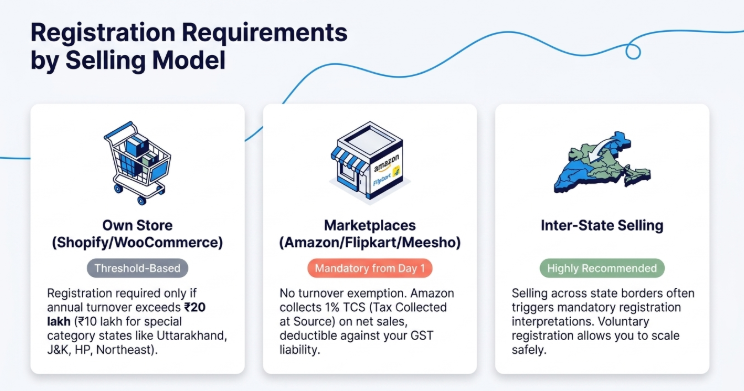
If you are running your own Shopify or WooCommerce store and your turnover is below ₹20 lakh, you can operate without GST registration. However, most serious dropshipping businesses register voluntarily for two reasons: it allows you to claim Input Tax Credit on your purchases, and it significantly improves your credibility with suppliers and payment gateways.
Inter-state selling:
If you are selling to customers in states other than your own — which is almost always the case in online dropshipping — some interpretations of GST law require registration regardless of turnover for inter-state supply. This is an area where consulting a GST practitioner is advisable before you scale.
GST and the Dropshipping Supplier Relationship
One of the most common questions from new clothing dropshippers is: does my supplier handle GST, or do I?
The answer is both — but in different parts of the transaction.
Your supplier is responsible for charging and remitting GST on the invoice they raise on you. Your responsibility is to charge and remit GST on the invoice you raise on your customer. These are two separate transactions in the eyes of GST law.
This is why choosing a GST-registered supplier is non-negotiable for serious dropshippers. If your supplier is not GST registered, you cannot claim Input Tax Credit on your purchases, which directly reduces your margins.
Experienced, established suppliers understand this completely. Snazzyway Dropshipping, which has been operating for over 12 years and works with more than 4,000 active sellers across India, is fully GST compliant. Every invoice they raise includes proper GST documentation, making ITC claims straightforward for their seller network. For clothing dropshippers in India, partnering with a supplier of this calibre removes significant compliance friction from day one.
Input Tax Credit: The Financial Advantage You Cannot Ignore
Input Tax Credit (ITC) is one of the most valuable — and most underutilised — provisions in GST for dropshipping resellers.
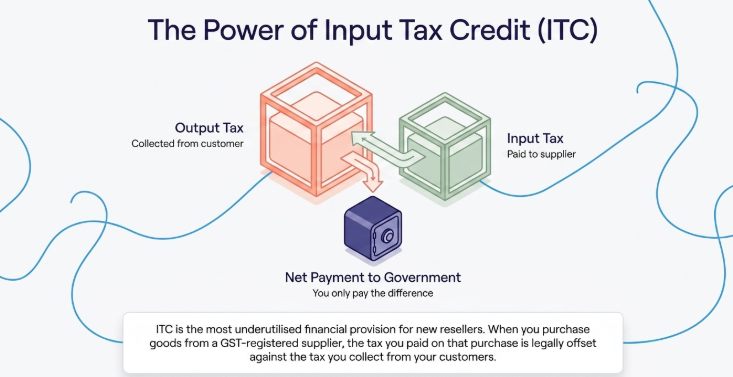
When you purchase goods from a GST-registered supplier, the GST you pay on that purchase can be offset against the GST you collect from your customers. You only pay the net difference to the government.
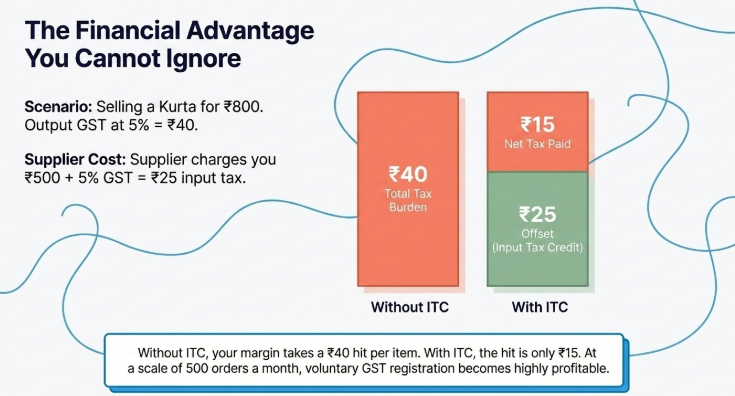
Example:
You sell a kurta for ₹800. GST at 5% = ₹40 collected from customer.
Your supplier charged you ₹500 + 5% GST = ₹25 as input tax.
Your net GST liability = ₹40 − ₹25 = ₹15.
Without ITC, you would pay ₹40. With ITC, you pay ₹15. At scale — say 500 orders a month — this difference becomes very significant.
To claim ITC correctly, you need: a valid tax invoice from your supplier with their GSTIN, your own GSTIN, and your supplier's GST returns to match your purchase records in the GSTR-2B auto-populated statement.
GST Invoicing Requirements for Clothing Dropshippers
Every sale you make as a GST-registered dropshipper requires a compliant tax invoice. The invoice must include:
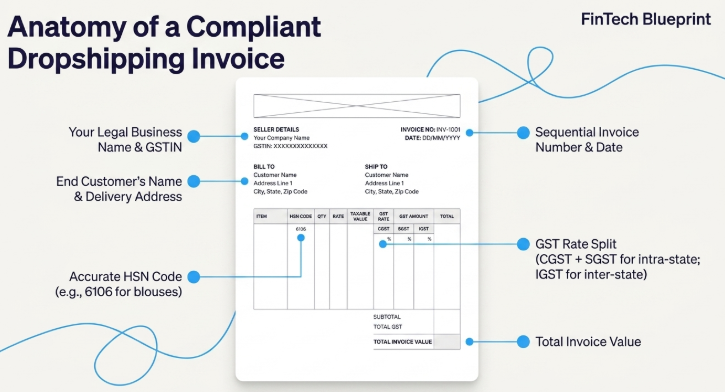
- Your legal business name and GSTIN
- Invoice number and date
- Customer's name and delivery address
- HSN code for the clothing item
- Description, quantity, and unit price
- GST rate and amount (CGST + SGST for intra-state, IGST for inter-state)
- Total invoice value
HSN Codes for Clothing:
HSN 6101–6117 covers knitted or crocheted garments. HSN 6201–6217 covers woven garments. For most readymade clothing in the dropshipping segment — kurtas, tops, dresses, leggings, ethnic sets — HSN codes in the 6100–6200 range apply. Lingerie and innerwear typically falls under HSN 6108 and 6212.
Getting the HSN code right is important because it determines the applicable GST rate and affects your GSTR-1 filing accuracy.
GST Returns: What Clothing Dropshippers Need to File
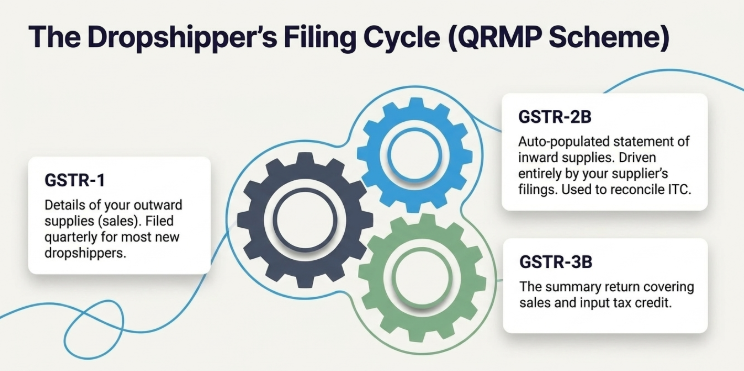
If you are GST registered, you are required to file returns on a regular basis. The primary returns for a dropshipping business are:
GSTR-1: Details of your outward supplies (sales). Filed monthly (if turnover above ₹5 crore) or quarterly under the QRMP scheme (if turnover below ₹5 crore). Most new dropshipping businesses qualify for quarterly filing.
GSTR-3B: A summary return covering both outward supplies and input tax credit. Filed monthly or quarterly depending on your scheme.
GSTR-2B: An auto-populated statement of your inward supplies (purchases) based on your suppliers' GSTR-1 filings. You use this to reconcile and claim ITC.
Annual Return (GSTR-9): Filed once a year summarising the full financial year's GST transactions. Mandatory for businesses with turnover above ₹2 crore.
Most clothing dropshippers starting out will file GSTR-1 and GSTR-3B quarterly under the QRMP scheme, with a monthly payment challan (PMT-06) for the first two months of each quarter.
GST Implications for Specific Dropshipping Models
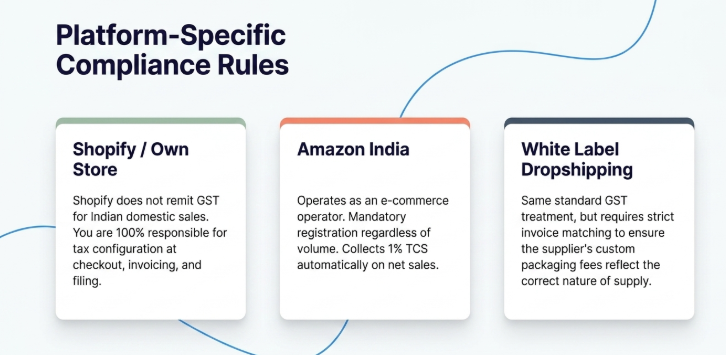
Standard clothing dropshipping (own store):
You collect GST on sales, claim ITC on supplier purchases, and file returns as described above. Straightforward once set up correctly.
Amazon dropshipping:
Amazon operates as an e-commerce operator under GST and collects TCS (Tax Collected at Source) at 1% on net sales made through their platform. This TCS is deductible against your GST liability. If you are exploring how to dropship on Amazon India, factor in Amazon's TCS mechanism and their requirement for mandatory GST registration regardless of your sales volume.
White label dropshipping:
When you sell under your own brand with custom packaging and labels, the GST treatment is the same as standard dropshipping — but your invoicing must correctly reflect your brand as the seller. If your supplier is doing custom labelling and packaging for you, ensure their invoice to you correctly reflects the nature of the supply. Sellers exploring white label dropshipping should work with suppliers experienced in this model to avoid invoice mismatches.
Shopify dropshipping:
Shopify does not collect or remit GST on your behalf for Indian domestic sales. You are fully responsible for collecting GST at checkout, issuing compliant invoices, and filing returns. If you are new to this and setting up your first store, understanding the full compliance picture before launch is important — a structured guide on how to start dropshipping on Shopify in India covers store setup alongside the compliance groundwork you need in place before your first order.
Common GST Mistakes Clothing Dropshippers Make
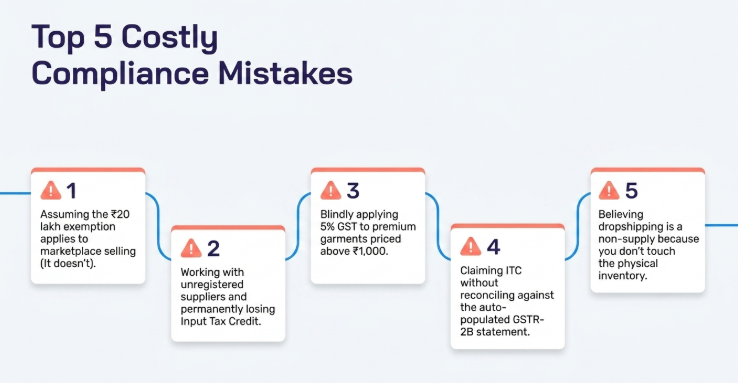
Mistake 1: Not registering when selling on marketplaces
Many new sellers assume the ₹20 lakh threshold applies to marketplace selling. It does not. Marketplace selling requires mandatory registration from day one.
Mistake 2: Working with unregistered suppliers
An unregistered supplier cannot issue a valid GST invoice. You lose ITC on every purchase, directly reducing your margins. Always verify your supplier's GSTIN before onboarding.
Mistake 3: Wrong GST rate application
Applying 5% GST to garments priced above ₹1,000 is a common error that creates mismatches in your returns and can trigger scrutiny. Price your products carefully and apply rates accurately.
Mistake 4: Not reconciling GSTR-2B
Many dropshippers claim ITC without verifying it against GSTR-2B. If your supplier has not filed their GSTR-1, your ITC claim will be blocked. Regular reconciliation prevents year-end shocks.
Mistake 5: Treating dropshipping as non-supply
Some new sellers assume that because they never touch the product, they are not making a supply under GST. This is incorrect. The moment you raise an invoice on a customer and collect payment, you are making a taxable supply.
Choosing a GST-Compliant Supplier: Why It Matters More Than You Think
Your GST compliance is only as clean as your supplier's compliance. A supplier who files returns late, has mismatches in their GSTR-1, or issues incorrect invoices creates direct problems for your ITC claims and your own return filings.
This is one of the less-discussed advantages of working with large, established B2B dropshipping suppliers. Suppliers with significant seller networks — like Snazzyway Dropshipping with its 4,000+ active seller base built over 12 years — have professional accounts teams that handle GST documentation correctly at scale. Their invoicing is clean, their GSTIN is consistently active, and their returns are filed on time, which means your ITC claims go through without friction.
When evaluating any new supplier for your clothing dropshipping business, checking their GSTIN status on the GST portal and reviewing sample invoices for compliance before placing your first order is a basic due diligence step that many new sellers skip — and regret later.
For a broader evaluation of suppliers across quality, reliability, and compliance, independently verified rankings like the top dropshipping suppliers in India ranked by HeadlessBiz provide a useful starting point that goes beyond supplier self-promotion.
Final Thoughts
GST compliance for clothing dropshipping in India is not complicated once you understand the structure. The 5% and 12% rate split, the ITC mechanism, the mandatory registration rules for marketplace sellers, and the invoicing requirements are all manageable — especially when you are working with a supplier who handles their end of the compliance chain correctly.
The sellers who struggle with GST are almost always the ones who either ignored it at the start and had to retrofit compliance later, or who worked with unregistered suppliers and lost months of ITC claims in the process.
Start compliant. Register at the right time. Choose a GST-registered supplier. File your returns on schedule. These four steps keep your dropshipping business legally clean and your margins protected as you scale.
Frequently Asked Questions
Q1. Is GST mandatory for all clothing dropshippers in India?
GST registration is mandatory if your annual turnover exceeds ₹20 lakh, or from the first rupee of sales if you sell on any e-commerce marketplace like Amazon, Flipkart, or Meesho. For sellers running their own Shopify or WooCommerce store with turnover below ₹20 lakh, registration is optional but strongly recommended to claim Input Tax Credit on supplier purchases.
Q2. What GST rate applies to women's clothing in dropshipping?
Women's clothing priced up to ₹1,000 per piece attracts 5% GST. Garments priced above ₹1,000 per piece attract 12% GST. This applies whether you are selling ethnic wear, western wear, lingerie, or loungewear. The rate is determined by your selling price to the end customer, not your purchase price from the supplier.
Q3. Can I claim Input Tax Credit as a clothing dropshipper?
Yes, provided you are GST registered and your supplier is also GST registered and files their returns correctly. The GST your supplier charges on your purchase invoice can be offset against the GST you collect from your customers, reducing your net tax liability. This ITC benefit is one of the strongest financial reasons to register for GST even before hitting the mandatory threshold.
Q4. Do I need a separate GST registration for each state I sell in?
No. A single GST registration in your home state covers inter-state sales. You charge IGST (Integrated GST) on sales to customers in other states, which is remitted to the central government. You only need multiple state registrations if you have a physical business presence — warehouse, office, or fulfilment centre — in more than one state.
Q5. What HSN code should clothing dropshippers use?
Most readymade garments fall under HSN Chapter 61 (knitted or crocheted) or Chapter 62 (woven). Common codes include 6104 for women's suits and dresses, 6106 for blouses and shirts, 6108 for innerwear and slips, and 6212 for bras and lingerie. Using the correct HSN code in your invoices and GSTR-1 filings is important for accurate rate application and return matching.
Q6. Does Shopify collect GST on my behalf for Indian customers?
No. Shopify does not collect or remit GST for Indian domestic sales. You are fully responsible for configuring GST rates in your Shopify store, collecting tax at checkout, issuing compliant invoices to customers, and filing your returns with the GST portal. Shopify does provide tax configuration settings that, once set up correctly, automate the calculation and display of GST at checkout.
Q7. What is TCS and how does it affect Amazon dropshipping in India?
TCS stands for Tax Collected at Source. E-commerce operators like Amazon are required under GST law to collect 1% TCS on net sales made through their platform and deposit it with the government on your behalf. This 1% appears in your GST electronic cash ledger and can be used to offset your GST liability or claimed as a refund. It is not an additional tax on top of GST — it is an advance collection that is fully credited to your account.
Q8. Can I run a dropshipping business without GST registration in India?
If you are selling exclusively through your own website, your turnover is below ₹20 lakh annually, and you are not making inter-state supplies that require registration, you can operate without GST registration. However, without registration you cannot claim ITC on your supplier purchases, cannot issue GST invoices to business buyers who need ITC, and cannot sell on any Indian e-commerce marketplace. For most serious clothing dropshippers, voluntary registration makes financial and operational sense well before the mandatory threshold is reached.