Cash on Delivery in Indian Dropshipping: Should You Offer It?
In India, Cash on Delivery (COD) isn’t just a payment option—it’s a trust-building tool. Even in 2025, while much of the world embraces seamless digital transactions, a large segment of Indian consumers still feels more secure paying in cash, once the product is in their hands.
But here’s the catch: when you’re running a dropshipping business—especially if you work with a clothing dropship vendor for Indian sellers —offering COD isn’t as simple as flipping a switch.
In this article, we’ll explore whether Cash on Delivery in Indian dropshipping is a smart move or a ticking time bomb. From benefits and hidden pitfalls to expert tips on managing COD effectively, this is your go-to guide before making the call.
Why COD Matters in the Indian Market
India is a unique eCommerce ecosystem. Despite increasing adoption of UPI and digital wallets, a huge percentage of online shoppers still trust COD as their go-to payment option. When you’re building a COD-enabled store, your platform matters just as much as your payment strategy—especially if you’re learning how to start dropshipping on Shopify in India with the right checkout and COD controls.

Key Stats:
- Over 60% of online transactions in tier 2 and 3 cities are still COD-based.
- 1 in 3 first-time online shoppers prefer COD over prepaid methods.
- Trust, lack of digital literacy, and fear of fraud are the main reasons behind this behavior.
For a new or small dropshipping store, especially one trying to build trust, offering COD can significantly increase conversions .
🔍 Snazzyway Insight: What 12+ Years in Indian COD Actually Taught Us
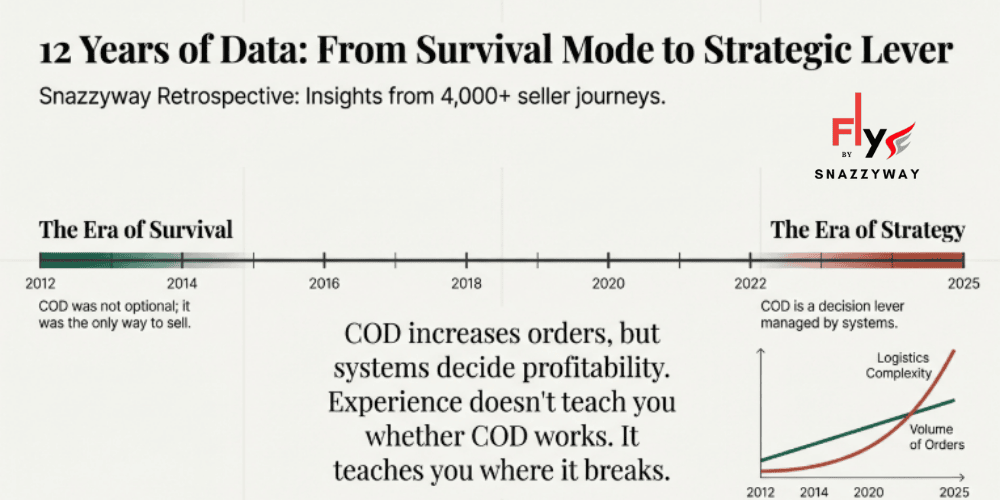
At Snazzyway, we’ve watched Cash on Delivery evolve from a necessity to a decision lever .
When we started over a decade ago, COD wasn’t optional — it was survival. Digital payments were limited, trust in online shopping was low, and customers wanted control till the last mile.
Fast-forward to today, after working with 4,000+ sellers , one pattern is clear: r—COD increases orders, but systems decide profitability. That’s why understanding how Snazzyway’s dropshipping system works is critical before enabling COD at scale.
COD increases orders, but systems decide profitability .
Sellers who treat COD as a blanket option often struggle with returns and cash flow. Sellers who treat COD as a controlled experiment — limited to specific pin codes, order values, and product categories — consistently outperform the rest.
Experience doesn’t teach you whether COD works. It teaches you where it breaks .
The Pros of Offering Cash on Delivery in Indian Dropshipping
1. Higher Conversion Rates
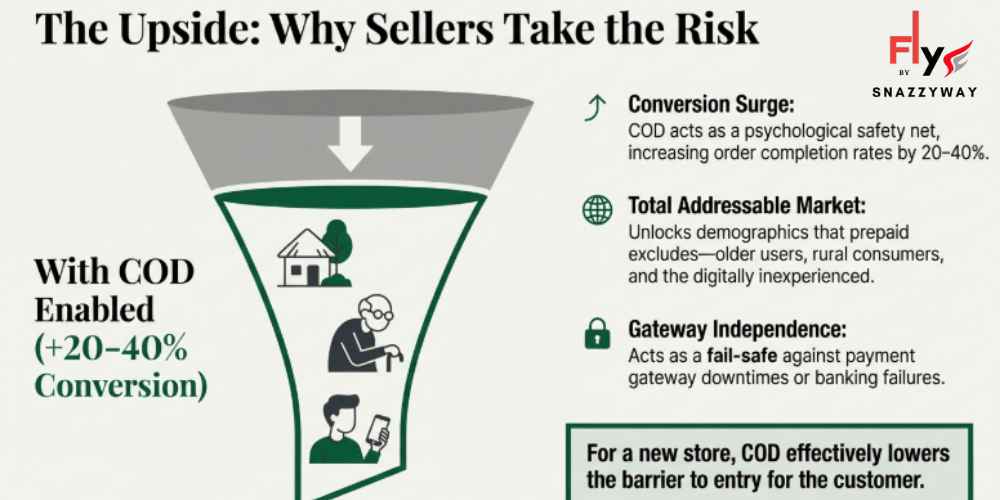
Fact: COD can increase order completion rates by 20–40% , particularly in non-metro areas.
2. Builds Trust
Most Indian shoppers are wary of scams or poor-quality products. COD gives them a psychological safety net—they pay only when they receive the product.
3. Wider Audience Reach
By offering COD, you tap into a massive audience that prefers cash transactions—including older users, rural consumers, and smartphone users with limited digital payment experience.
4. No Payment Gateway Dependency
If your payment gateway faces downtime or fails to support Indian banks or wallets properly, COD becomes a solid fallback. That’s why choosing from the best payment gateways for Shopify dropshipping in India is just as important as offering COD.
⚠️ The Side of COD Most Blogs Don’t Talk About
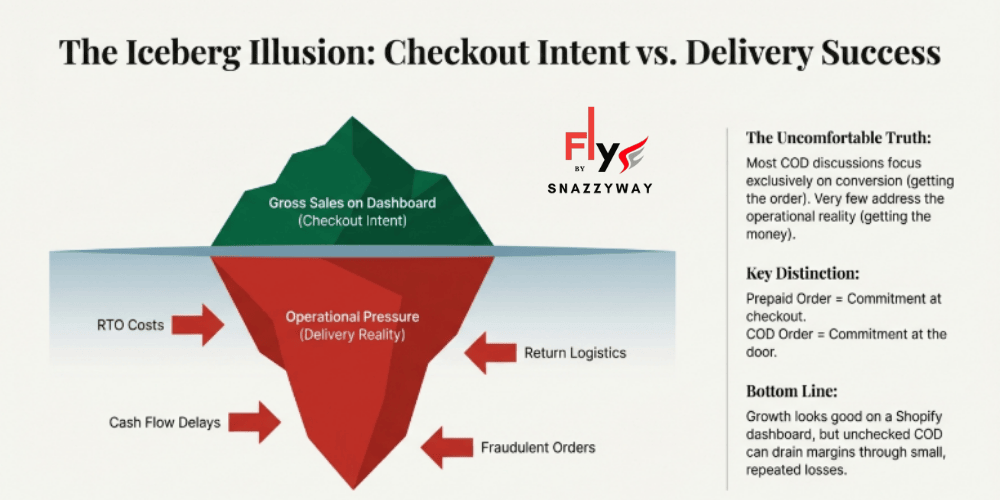
Most COD discussions focus on conversion. Very few talk about operational pressure .
Here’s the uncomfortable truth we’ve seen repeatedly:
- COD orders need more follow-ups
- Delivery success depends on customer intent, not checkout intent
- Growth looks good on dashboards — but profits lag behind
Many new dropshippers mistake more orders for better business. In reality, unchecked COD can quietly drain margins through small, repeated losses that only show up months later.
That’s why COD feels powerful early — and painful at scale.
The Hidden Challenges of Cash on Delivery in Indian Dropshipping
Despite its appeal, COD isn’t all sunshine and high sales. Here are the key pitfalls that can crush your profits if not managed wisely.
1. High Return-to-Origin (RTO) Rates
This is the biggest pain point. In COD orders, customers often refuse to accept the package , leading to:
- Wasted shipping costs
- Product loss or damage in return transit
- Additional handling and reshipping efforts
RTO rates for COD orders can be as high as 30–40%.
COD works very differently on marketplaces, and sellers exploring how to dropship on Amazon in India must account for stricter logistics, higher penalties, and limited control compared to their own store.
2. Increased Operational Costs
You have to pay the shipping provider extra to handle cash, plus you bear the cost of RTO and failed delivery attempts. These charges eat heavily into already-thin dropshipping margins.
3. Complex Cash Flow
Cash collection delays affect liquidity. Courier partners may take 7–15 days to settle COD payments. For dropshippers working with slim capital, this can choke reinvestment cycles.
4. Fraud and Fake Orders
Some buyers misuse COD for pranks or impulsive purchases. They might place an order and refuse it later, knowing there’s no prepaid commitment.
🚫 Why COD Stops Working After a Point
COD is excellent for first-time buyers .
It’s inefficient for repeat buyers .
Once a brand starts getting consistent traffic, social proof, and returning customers, COD begins to create friction instead of trust.
We’ve seen sellers hit a ceiling where:
- Ad spend increases
- Order volume rises
- But net profit stays flat
In almost every case, excessive COD dependence was part of the problem.
Growth requires predictable cash flow . COD introduces unpredictability.
Should You Offer COD in Your Dropshipping Store?
There’s no one-size-fits-all answer. It depends on:
Best Practices for Managing COD in Indian Dropshipping
If you decide to offer COD, here are smart ways to minimize its risks:
1. Add COD Charges
Charge a small fee (e.g., ₹49–₹99) to discourage casual buyers and cover RTO costs.
2. Enable COD for Select Products Only
Avoid offering COD on high-value or high-return items like lingerie, electronics, or custom products.
3. Implement Order Verification
Use OTP confirmation or WhatsApp follow-ups to validate orders before shipping.
4. Partner With COD-Friendly Dropshipping Suppliers
To offer Cash on Delivery in Indian dropshipping , work with clothing Dropshipping suppliers who support COD logistics. Look for fast shipping, branded packaging, and RTO management.
5. Track RTO Analytics
Monitor your RTO data by:
- Product category
- Region
- Order value
This helps you optimize what items should or shouldn’t be sold via COD.
6. Use “COD Available” As a Marketing Hook
Highlighting COD availability in ads or product pages can boost CTR and conversions—especially in Facebook or Instagram ads targeting Bharat audiences.
What Successful Indian Dropshippers Are Doing
Many Indian dropshipping brands take a hybrid approach:
- They offer COD + Prepaid options.
- They incentivize prepaid by offering discounts (e.g., “Get ₹50 off on prepaid orders”).
- They limit COD to repeat-verified customers or use it only during launch periods to build initial traction.
Dropshippers working with white-label partners like Snazzyway have additional advantages because they can add custom packaging and brand labels—this improves trust and reduces COD-related cancellations.
💡 How Smart Sellers Use COD (Without Letting It Control Them)
From thousands of seller journeys, the best performers follow a simple rule:
COD is an entry door, not the main hall.
They:
- Offer COD selectively, not universally
- Push prepaid incentives after the first successful delivery
- Track COD performance weekly, not emotionally
- Remove COD faster than they add it
This mindset shift — from “COD = more trust” to “COD = temporary leverage” — is what separates sustainable brands from short-term stores.
Conclusion: To COD or Not to COD?

Offering Cash on Delivery in Indian dropshipping is a double-edged sword. While it can boost your sales and customer trust, it also comes with risks that can hurt your profit margins if left unmanaged.
The key is to approach COD strategically:
- Use it to build trust.
- Track and optimize RTO data.
- Combine it with prepaid incentives.
- Work with reliable shipping and fulfillment partners.
If you play your cards right, COD can be your best ally in growing a trustworthy and scalable dropshipping business in the Indian market.
🧠 Final Snazzyway Perspective
COD isn’t good or bad.
It’s situational .
For new sellers, it builds confidence.
For growing sellers, it demands discipline.
For scaled brands, it’s often optional.
After 12+ years in Indian eCommerce, one thing is consistent:
The sellers who last the longest are not the ones who sell the most — they’re the ones who control how they get paid .
Your Questions Answered
Whether to offer COD for dropshipping in India depends on your product category, target geography, and operational readiness to manage the associated risks. COD increases order completion rates by 20–40%, particularly in Tier-2 and Tier-3 cities and among buyers unfamiliar with digital payments — making it essential for stores targeting a broad Indian audience. However, COD carries significant operational costs: courier partners take 7–15 days to remit collected cash, RTO rates on COD orders typically run 25–40% in fashion categories, and each non-delivered order generates two-way courier losses with no revenue. The recommended approach for most Indian dropshippers is a hybrid COD strategy: offer both COD and prepaid, incentivize prepaid with a ₹30–₹50 discount per order, implement WhatsApp or OTP confirmation before dispatching COD orders, and avoid offering COD on high-return categories like custom products or very high-value items. This hybrid approach captures the conversion benefit of COD availability while actively steering buyers toward prepaid transactions that eliminate RTO risk entirely.
Indian buyers' preference for COD is rooted in four structural factors specific to India's e-commerce development. First, trust deficit with unknown brands — 62% of Indian customers prefer COD over prepayment for online purchases, particularly from brands they have not bought from before. Paying cash on receipt eliminates the risk of paying for a product that never arrives or looks different from the listing. Second, digital literacy variation — India's 918 million internet users represent vastly different levels of comfort with online transactions; rural consumers, older buyers, and first-generation smartphone users are significantly more comfortable with cash than with card or UPI payments for e-commerce. Third, product inspection preference — Indian consumers have a strong cultural preference for examining purchases before payment, similar to the physical retail experience; COD recreates this psychologically even when the buyer cannot physically inspect before payment is collected. Fourth, online security concerns — despite UPI's explosive growth, a significant segment of Indian buyers remains concerned about card fraud and phishing, making COD the perceived safer option for online purchases. These factors make COD not merely a payment preference but a trust-building mechanism that unlocks a large buyer segment that would not purchase from prepaid-only stores.
RTO — Return to Origin — occurs when a dispatched order is not accepted by the customer at delivery and is returned to the sender. In Indian COD dropshipping, RTO happens most commonly when: a buyer places an impulsive COD order with no financial commitment and then refuses delivery; the buyer is unavailable at the delivery address after multiple courier attempts; the buyer places a prank or test order with no intent to purchase; or the address provided is incorrect or incomplete. The cost of each RTO event includes the outbound shipping cost (approximately ₹60–₹100), the return shipping cost (approximately ₹40–₹70), and the product opportunity cost if the item cannot be restocked immediately. At a 30% COD RTO rate on 100 monthly orders with ₹700 average order value, a seller absorbs approximately ₹3,900–₹5,100 in pure RTO shipping losses per month — before accounting for any product damage during transit. Snazzyway Fly's built-in fake order detection automatically flags orders from addresses with past non-delivery records and can block high-risk COD orders before dispatch, reducing RTO by up to 30–50% compared to unmanaged COD operations.
Reducing COD RTO in Indian dropshipping requires a multi-layer approach combining technology, incentives, and operational policy. First, WhatsApp or OTP order confirmation: immediately after a COD order is placed, send an automated WhatsApp message asking the buyer to confirm their order with a simple reply. Orders that don't receive confirmation within 2–4 hours can be flagged for review or cancelled before dispatch — this single step alone reduces impulsive fake orders significantly. Second, COD fee: charge a nominal fee of ₹49–₹99 on COD orders to create a small financial commitment that discourages completely impulsive buyers while remaining non-deterrent for genuine purchasers. Third, prepaid incentive: offer a visible discount of ₹30–₹50 for prepaid orders — positioning it not as a COD penalty but as a "prepaid advantage" — which shifts a meaningful percentage of COD-intent buyers to prepaid. Fourth, address verification: cross-check the delivery address and phone number against historical non-delivery records before dispatch. Fifth, product-level COD restriction: disable COD for specific high-risk or high-value products where return rates are historically elevated, while keeping COD available on lower-risk items. Well-managed Indian dropshipping operations using these combined tactics typically achieve COD RTO rates of 10–18% — versus the 25–40% experienced by sellers with no COD management system.
Prepaid is more profitable per order for Indian dropshipping, but COD generates higher total order volume — making the optimal approach a hybrid model that captures both. A prepaid order eliminates RTO risk entirely, settles payment immediately into the seller's payment gateway (typically T+1 to T+3 settlement), and involves no cash remittance delay. At a net margin of ₹200 per order, 100 prepaid orders generate ₹20,000 net with zero RTO loss. The same 100 orders on COD at 30% RTO generates 70 successful deliveries (₹14,000 margin) minus approximately ₹4,500 in RTO shipping losses — net ₹9,500, less than half the prepaid equivalent. However, offering only prepaid typically reduces conversion rate by 30–40% compared to COD-enabled stores in India, meaning prepaid-only stores generate significantly fewer total orders that partially offset the per-order profit advantage. The financially optimal configuration is prepaid with a ₹40–₹50 incentive (shifting buyers from COD to prepaid) combined with managed COD for buyers who choose it — with WhatsApp confirmation and RTO management actively minimizing the COD loss rate.
COD payment settlement in India typically takes 7–15 working days from the date of successful delivery — this remittance lag is one of the most significant cash flow challenges for Indian dropshippers. The process works as follows: the courier collects cash from the buyer at delivery, deducts its handling and COD fees (typically ₹25–₹60 per order depending on courier and order value), and transfers the remaining amount to the seller's bank account in batches — usually weekly or bi-weekly depending on the courier partner's remittance schedule. For a dropshipping seller processing 200 COD orders per month at ₹700 average order value, approximately ₹1,40,000 in COD revenue can be in transit with the courier at any given time — unavailable for reinvestment into advertising, stock purchases, or operational costs. This lag is amplified during festive season sales peaks when order volumes spike and courier processing queues slow remittance timelines. Managing COD cash flow requires maintaining sufficient working capital to cover supplier payments and advertising costs during the 7–15 day settlement gap, which is why experienced Indian dropshippers actively incentivize prepaid payments to improve cash flow velocity even when COD remains available as an option.