
Dropshipping Trends 2026: Data, Market Shifts & New Growth Rules Every Seller Must Know
Dropshipping has completely transformed over the last decade—but 2026 marks a new era in the industry. What once worked—basic AliExpress sourcing, generic products, slow shipping—no longer brings profit. Today, the sellers who succeed are the ones who understand data, AI, brand-building, private label, fast fulfilment, and most importantly, choosing reliable dropshipping suppliers that can scale with their business.
👉 This shift is part of a bigger transition happening across ecommerce — moving from product selling to brand building , where long-term systems matter more than viral products.
In this comprehensive report, we deep-dive into the Top Dropshipping Trends 2026, backed by market data, growth stats, and real-world shifts that every seller must understand.
The Global Dropshipping Market is Projected to Hit $1.3 Trillion by 2026
The dropshipping industry is expanding rapidly, surpassing expectations globally.
Key Statistics
- The global dropshipping market is expected to reach $1.3 trillion by 2026.
- The market continues to grow at a 23–25% CAGR (compound annual growth rate).
- Fashion, beauty, wellness, and home improvement remain the top-grossing niches.
Why this matters
The world has moved towards convenience shopping. Consumers care less about where a product comes from and more about:
- price
- fast shipping
- product uniqueness
- brand trust
This fuels the next-generation dropshipping ecosystem—one driven by automation, private label, and premium customer experience.
India Becomes One of the Fastest-Growing Dropshipping Hubs by 2026
India’s e-commerce ecosystem is exploding like never before. With UPI, ONDC, cheap data, and social commerce, more sellers are entering the online retail world—and dropshipping is benefitting the most.
Key India-Specific Data
- India’s e-commerce market will surpass $200 billion by 2026.
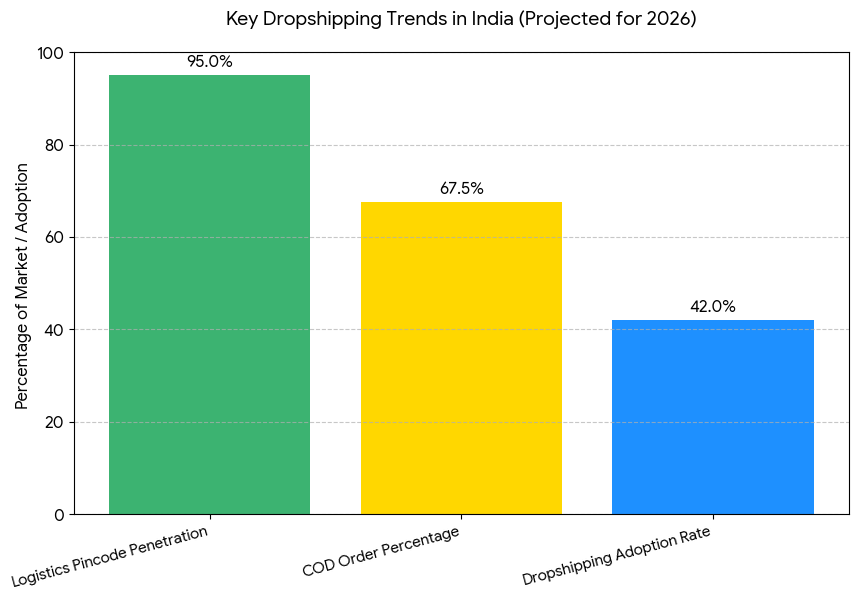
- 42%+ of new online sellers are choosing dropshipping as their entry model.
- Cash-on-Delivery (COD) still accounts for 65–70% of orders.
- Logistics penetration has increased to 95%+ of India’s pincodes.
👉 These trends align closely with top ecommerce predictions for Indian dropshipping in 2026 , where India is expected to dominate global seller growth.
What this means for sellers
India in 2026 favours:
- Fast-moving categories like lingerie , beauty, wellness, home essentials, and apparel
- Low-investment business models like dropshipping
- Quick setup using Shopify, WooCommerce, ONDC integration
- Tier-2 and Tier-3 shoppers who prefer COD
India is no longer just a buyer’s market—it’s now a goldmine for dropshippers.
AI & Automation Will Power 70% of Dropshipping Tasks by 2026
AI is no longer optional—it is the backbone of modern e-commerce.
AI Dropshipping Data
- 70% of dropshippers in 2026 will use AI for daily operations.
- AI creatives reduce ad costs by 18–32%.
- AI chatbots cut customer support workload by 40–60%.
- AI inventory syncing prevents 30–35% of order cancellations.
AI Tools Impacting Dropshipping
- AI product research to find trending items
- AI ad scripts and creative generation
- AI pricing automation
- AI customer service bots
- AI competitor analysis
Why this matters
AI helps:
- scale faster
- reduce mistakes
- improve margins
- automate repetitive tasks
In 2026, a dropshipper using AI can outperform a manual seller by 5X efficiency.
Fast Shipping Becomes Non-Negotiable in 2026
Five years ago, customers tolerated 15–30 day shipping. Today? They quit within seconds.
Shipping Data 2026
- 1 in 3 shoppers abandon carts if delivery exceeds 5 days.
- Dropshippers offering 3–5 day delivery see 40–55% higher conversions.
- Return rates drop by 18% when delivery is fast.
Major Shipping Shifts in 2026
- Local fulfilment centres
- Domestic suppliers like Snazzyway offering same-week delivery
- Real-time tracking expectations
- Faster refunds and replacement cycles
👉 This is why sellers increasingly want clarity on how Snazzyway dropshipping works , especially for fast delivery, COD handling, and white-label fulfilment.
The new rule
Slow shipping = no sales.
Fast shipping = higher trust, more conversions, more repeat buyers.
White Label Dominates the 2026 Dropshipping Landscape
Gone are the days when generic AliExpress products worked. Consumers now want:
Shipping Data 2026
- trustworthy brands
- quality packaging
- brand identity
White Label 2026 Data
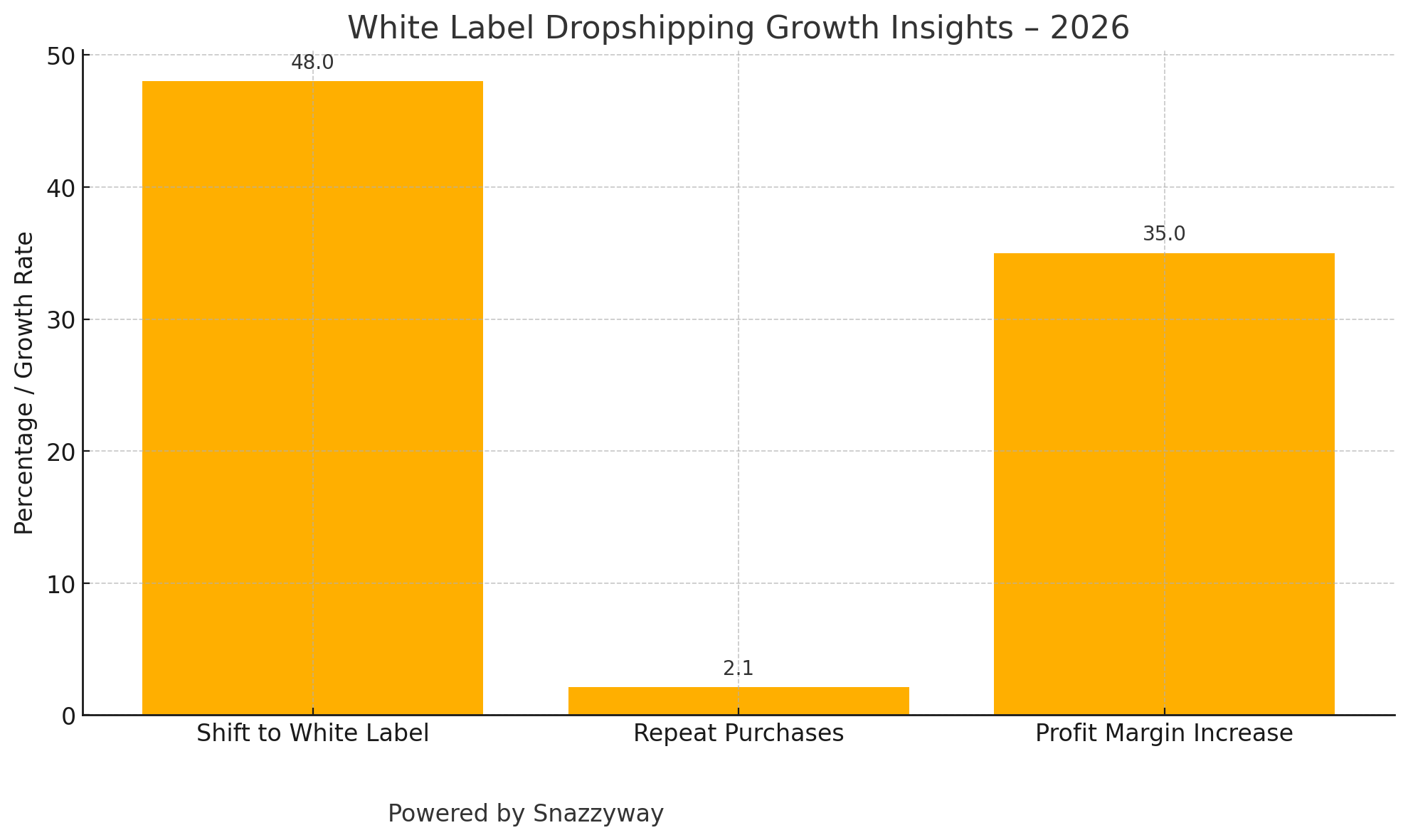
- 48% of dropshippers have shifted to white label.
- White label stores enjoy 2.1X more repeat purchases.
- Profit margins increase by 25–45% when branding is involved.
👉 Generic product lists are fading fast, which is why sellers must be selective even when choosing best products for dropshipping in India , focusing on branding potential rather than just demand.
Why white label wins
- Control over packaging
- Better profit margins
- Lower return rates
- Higher customer loyalty
- Ability to charge premium prices
White label dropshipping is the difference between a temporary dropshipping hustle and a long-term e-commerce brand.
Social Commerce Will Drive 30–40% of Dropshipping Sales
2026 is all about video-first shopping. Gen Z and Millennial buyers are making purchases directly through:
Instagram Reels
- TikTok Shops
- YouTube Shorts
- Live selling
- Influencers
- UGC content
Social Commerce Data 2026
- Social commerce will contribute up to 40% of online retail sales.
- Short video ads convert 6.5X better than image ads.
- 67% of shoppers trust UGC-style product videos more than branded ads.
The big shift
Your store doesn’t sell your product.
Your content does.
A seller with:
- viral reels
- influencer partnerships
- UGC reviews
will outperform others massively in 2026.
Subscription-Based Dropshipping is Growing 80% Faster YoY
Subscription models create recurring income, predictable revenue, and high retention.
Subscription Model Data
- Recurring revenue models show 80% year-over-year growth.
- Categories thriving in subscription dropshipping:
- Beauty boxes
- Lingerie subscription boxes
- Wellness boxes
- Self-care kits
- Men’s grooming kits
Why subscriptions explode in 2026
- Customers love convenience
- You earn monthly recurring revenue
- Lifetime customer value (LTV) increases by 3–4X
- Lower ad cost per customer
- Higher retention
The big shift
2026 is the year sellers move from one-time sales to monthly recurring sales.
The New Growth Rules Every Dropshipper Must Follow in 2026
Subscription models create recurring income, predictable revenue, and high retention.
Based on all the data above, these are the 2026 success rules :
📌 Rule #1: Don’t Sell Generic Products
Only sell unique, premium, or private-label items.
📌 Rule #2: Prioritize Fast Shipping
Aim for 3–5 days max.
📌 Rule #3: Build a Brand, Not a Store
Branding > Product.
📌 Rule #4: Use AI for Everything You Can
Your competitors already are.
📌 Rule #5: Be Active on Video Platforms
Reels, Shorts & TikTok will drive sales.
📌 Rule #6: Offer COD + Prepaid Options
India especially requires hybrid payment methods.
📌 Rule #7: Use UGC Content and Influencers
Authentic content converts better than professional ads.
📌 Rule #8: Explore Subscription Models
Your best people want a recurring box.
📌 Rule #9: Focus on Customer Experience
Tracking, returns, quality, and communication matter more in 2026.
👉 To support this hybrid model efficiently, sellers must also choose the right payment gateways for Shopify dropshipping , especially for Indian customers.
Conclusion: Dropshipping in 2026 is Profitable — but Only for Smart Sellers
The dropshipping industry is not dying—it is evolving .
2026 brings unprecedented growth, but only for sellers who:
- use AI
- focus on branding
- prioritise fast delivery
- sell high-quality products
- build trust through UGC
- adopt subscription models
- optimize through data-driven strategies
Those who adapt to these Dropshipping Trends 2026 will build profitable, sustainable, long-term e-commerce brands.
📚 Related Reading
100+ Innovative Dropshipping Business Ideas to Spark Your Inspiration
Dropshipping in Tier 2 and Tier 3 Cities India – A Complete Guide for 2025
How to Build a Dropshipping Brand People Actually Remember (Not Just Buy From)
From Product Selling to Brand Building: The New Era of Dropshipping Entrepreneurs